Olympic Bench Weight 🏋️ (The Bar!)
The "Olympic Bench Weight" Question
This is a very common, and very smart, question. What is the "Olympic bench weight"? This question is confusing. It is "ambiguous." It can mean two very different things. 1. What is the weight of the BENCH? (The "furniture" you lie on). ( 2. What is the weight of the BAR? (The "barbell" you lift). ( Let's be very clear. 99% of the time... ...people are asking about the BAR. The "bar" is the "Olympic" part. It is the standardized part. This guide will answer both questions. We will start with the most important one. The one you must know. How much does the bar weigh? This is not medical advice. 🩺 The bench press is a dangerous exercise. Always lift with a spotter. Always be safe.
Part 1: The BAR Weight (The 45lb Answer) 👑
This is the "gold standard" answer. This is the #1 fact of the gym. You must memorize this. When you see a standard, 7-foot bar... ...in a squat rack or on a bench press... ...it is an Olympic Barbell. A standard Men's Olympic Barbell weighs:
- 45 POUNDS (lbs)
- 20 KILOGRAMS (kg)
The "Kilogram" Confusion (The 20kg Bar) 🇪🇺
This is a small, "pro-level" confusion. Is it 45 lbs? Or 20 kg? They are not the same! A 20 kg bar is 44.1 pounds. It is not 45 lbs. Why the difference? 1. "Competition" Bars (20kg): A real, "competition" Olympic bar... ...(like an "Eleiko" or "Rogue" bar)... ...is made to kilogram standards. It is exactly 20 kg. (44.1 lbs). ( 2. "Gym" Bars (45lb): Most "commercial gym" bars... ...(like the one at your local gym)... ...are made in America. They are made to pound standards. They are manufactured to be exactly 45 lbs. The Verdict: Does this 0.9 lb difference matter? No. Not for 99.9% of people. Just assume the bar is 45 lbs. It is the "universal" number. It is what everyone uses. It is the "gym-math" answer.
Features of the 45lb Olympic Bar
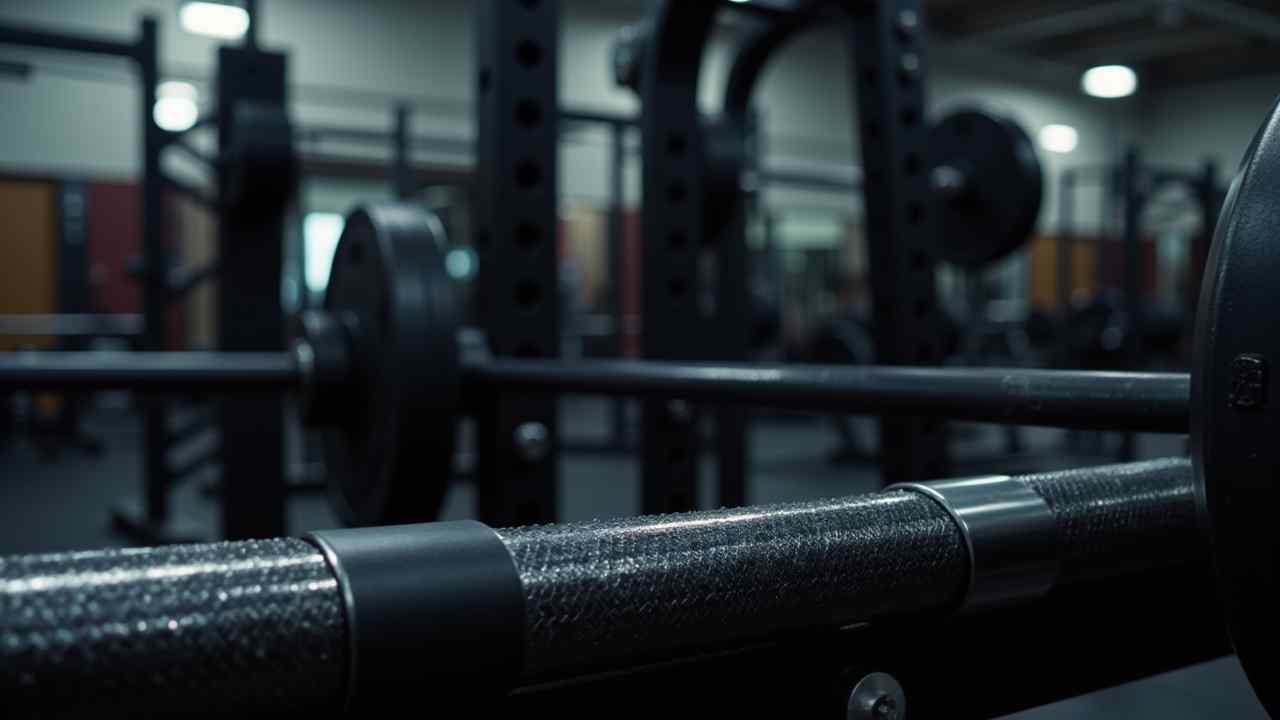
This bar is a "pro" tool. It is not just a "stick." Length: 7.2 feet (2.2 meters). Shaft Diameter: 28.5mm - 29mm. (This is the "grip" part). ( Sleeves: This is the most important part. The "sleeves" are the ends. They are 2 inches (50mm) thick. This is the "Olympic" size. It only fits 2-inch Olympic plates. Spinning Sleeves: The sleeves spin. They are on bearings or bushings. This is a critical safety feature. When you lift, the "plates" spin. The "bar" (your hands) does not. This protects your wrists and elbows... ...from "torque" and injury. Knurling: This is the rough, "diamond" pattern. It is for your grip. It stops the bar from slipping.
The "Other" Olympic Bar (The 33lb Bar) 🏋️♀️
What if the bar looks "thinner"? You may be using the Women's Olympic Bar. It is also a "pro" bar. How much does it weigh? A Women's Olympic Bar weighs:
- 33 POUNDS (lbs)
- 15 KILOGRAMS (kg)
The DANGER: The "Standard" Bar Trap 🚫
This is the most important part of this guide. All of the above... ...is about "OLYMPIC" (2-inch) bars. There is another type of bar. The "Standard" bar. This is the "cheap" bar. It is sold in "home gym" sets. (At stores like Walmart or Target). ( The Key Difference: The "sleeves" (the ends) are 1 INCH thick. Not 2 inches. This is the "small hole" system. It only fits 1-inch plates. How much does this bar weigh? WHO KNOWS? It is NOT standard. It could be 10 lbs. It could be 15 lbs. It could be 20 lbs. It is often hollow. It is not 45 lbs. The DANGER: These bars are NOT SAFE for a heavy bench press. They are not designed for it. They can bend. They can break. The sleeves do not spin. If you are at a "real" gym... ...you are 99.9% safe. You are using a 45lb Olympic bar. If you are at a "home" gym... ...you must check your bar. Is it a "1-inch" or "2-inch" bar? If it is 1-inch, be very careful.
Part 2: The "Bench" Weight (The Furniture)
Now, let's answer the other question. How much does the bench (the furniture) weigh? The answer is simple: It is NOT standard. It varies wildly. A "bench" is just a steel frame. And a padded board. The weight depends on the quality of that steel. H
1. The "Home" Bench (Light-Duty)
This is a "home-use" adjustable bench. (Like a "folding" bench). ( These are light. They are designed to be moved. They often weigh 30 to 60 pounds. They also have a low weight capacity. (e.g., 300-500 lbs, total). (This is a risk! (See the "Safety" section). (
2. The "Commercial" Bench (Heavy-Duty) 🛡️
This is the "pro" bench. The one you see at a real gym. The one that is "bolted together." These benches are TANKS. They are designed to be heavy. They are designed for stability. A commercial "flat bench" (like a "Rogue" bench)... ...can weigh 100 to 150+ pounds. Why so heavy? Stability. When you are benching 300 lbs... ...you do not want your bench to "wobble"! The heavy weight comes from thick steel. (A heavy "gauge" of steel). (This is a "pro-level" piece of equipment.
What is an "Olympic Bench"? (The Station)
This is the final term. What is an "Olympic Bench Press"? It is a "station." It is one piece of furniture. It combines two parts:
- The Bench (the pad you lie on).
- The Rack (the "uprights" that hold the bar).
CRITICAL: Bench Press Safety (The Rules) 🚨
This is the most important part of this guide. You are asking about the "bench." You must know the safety rules. The Bench Press is the most dangerous lift in the gym. Period. You can die doing this lift. (If the bar falls on your neck or chest). ( You must follow these rules. No exceptions.
Rule 1: ALWAYS Use a Spotter (The Best Way)
This is the #1 rule. Never, ever, "max out"... ...without a spotter. A spotter is your "lifeguard." If you "fail" the rep... ...they will grab the bar. They will save your life. Do not be afraid to ask for a spot. Everyone in the gym understands. It is part of the "code" of lifting.
Rule 2: The "Alone" Hack (The Power Rack) 🛡️
This is the "home gym" or "alone" rule. You can lift alone. But you must be smart. Do NOT use a "fixed" bench press station! (It has no safeties!). ( You must use a Power Rack (a "cage")... ...and a separate, adjustable bench. T A Power Rack has Safety Pins (or "spotter arms"). This is the "Save-Your-Life" Hack: Before you lift, set the pins. Set them at the correct height. The height should be 1 inch above your chest. When you are "arched." This means you can do a full rep. (The bar will touch your chest). ( But if you fail... ...and you "relax" your arch... ...the bar will land on the PINS. Not on your NECK. You can then "wiggle" out from under it. 100% safe. This is the only way to bench heavy, alone.
Rule 3: NEVER Use the "Suicide Grip" 🚫
This is a grip trap. You will see "bros" do this. It is stupid. The "suicide grip" (or "thumbless" grip)... ...is when you do not wrap your thumb... ...around the bar. Your thumb is next to your fingers. Why is this a "suicide" grip? Because you have no lock. The bar is just "resting" on your palm. If your wrist "bends" wrong... ...the bar will roll out of your hand. And onto your face or neck. ALWAYS wrap your thumb. Always.
Rule 4: The "No Clips" Debate (The "Roll of Shame")
This is a weird, "advanced" rule. It is counter-intuitive. It is a "last resort" safety. The Rule: If you are benching WITHOUT a spotter... ...and WITHOUT a power rack... (i.e., you are being very stupid)... ...you must NOT use clips (collars). Why? Clips lock the weight on. This is a danger. If you fail, you are trapped. (You cannot get the 135 lbs off your chest). ( But if you have no clips... ...you can do the "Roll of Shame." Or the "Dump." You can TILT the barbell. Tilt it to one side. The 45lb plate will slide off. (Crash!). ( The other side will then fly up. (Crash!). ( This is loud. It is embarrassing. It is messy. But you are alive. The bar is off you. The "Pro" Rule: Use a Power Rack with Safeties. Then you can (and should) use clips.
Conclusion: The 45lb Standard
Let's summarize the final answers. 1. The "Olympic Bench" BAR: The "bar" is the standard. It weighs 45 POUNDS (20 KG). This is the answer you are looking for. (The "Women's" bar is 33 lbs / 15 kg). ( 2. The "Olympic BENCH": The "bench" (the furniture) is NOT standard. It can weigh 50 lbs (home) or 150+ lbs (gym). The weight is not the "point." The stability is. 3. The "Standard" Bar (1-Inch): This is the "trap" bar. It is NOT Olympic. Its weight is unknown (10-20 lbs). It is NOT safe for a heavy bench press. 4. The Safety Rule: The bench press is dangerous. NEVER lift heavy and alone... ...without a Spotter or a Power Rack. Period. Now you know the answer. The bar is 45 lbs. Go lift safely. 🌟