45 Pound Weight Plates 🏋️ (The Guide)
What is a 45 Pound Weight Plate?
A 45-pound weight plate is an icon. It is a "symbol" of strength. It is the "king" of the gym plates. It is the largest, "standard" plate. It is the "default" plate. In the gym, if someone says... ..."Hand me a plate"... ...they mean a 45-pound plate. It is not just a "weight." It is a unit of measurement. We "measure" our strength... ...in "45-pound plates." (e.g., "He benches 2 plates."). ( This guide will explain everything... ...about this "45-pound" world. It will explain the "gym math." It will explain the "types." And it will explain the "traps."
The #1 CRITICAL Choice (Olympic vs. Standard) 🚫
This is the most important part of this guide. You must read this before you buy anything. You must. This is the #1 mistake beginners make. It is a very expensive mistake. There are two systems of weight plates. They are 100% incompatible. They do not work together.
1. "Standard" Plates (The 1-Inch Trap) 🚫
This is the "cheap" set. The "beginner" set. You find it in department stores. (Like Walmart or Target). ( The "Standard" system uses plates... ...with a 1-inch center hole. This is the "small hole." A "Standard" 45lb plate is rare. And it is not what people mean. It is a "dead-end" system. Do not buy it. You will outgrow it in 6 months. And your 1-inch plates will not fit... ...on the 2-inch "real" bars at the gym. You are wasting your money. 💸
2. "Olympic" Plates (The 2-Inch Standard) ✅
This is the "pro" system. This is the system you must invest in. The "Olympic" system uses plates... ...with a 2-inch (50mm) center hole. This is the "big hole." This is the global standard. It is strong. It is safe. It is what all real gyms use. The Rule: When we say "45-pound plate"... ...we ONLY mean an Olympic (2-inch) plate.
The "Gym Math": Why 45lbs? 🔑
This is the core of the subject. Why this specific, weird number? Why not "50 lbs"? The answer is simple. It is because of the BAR.
The Bar is 45 Pounds!
The "king" of the gym... ...is the 7-foot Olympic Barbell. And this bar weighs... ...45 POUNDS. (Or 20kg, which is 44.1 lbs. We call it 45). ( This "45lb bar" + "45lb plates"... ...creates a beautiful, simple "Gym Math." It makes "calculating" your lift... ...very, very easy. It is a "language."
The "Plate Math" (The 3 Milestones)
This is the "language" of the gym. We talk in "plates." A "plate" means a 45lb plate per side.
1. "One Plate" (The 135lb Lift)
This is the first big milestone. "He can bench 1 plate!" What does this mean? It means:
- 1 x 45 lb Bar
- + 1 x 45 lb Plate (Left side)
- + 1 x 45 lb Plate (Right side)
- TOTAL: 135 POUNDS
2. "Two Plates" (The 225lb Lift)
This is the "intermediate" milestone. It is a very respectable lift. "He squats 2 plates." " What does this mean? It means:
- 1 x 45 lb Bar
- + 2 x 45 lb Plates (Left side)
- + 2 x 45 lb Plates (Right side)
- TOTAL: 225 POUNDS
3. "Three Plates" (The 315lb Lift)
This is the "advanced" milestone. This is a "strong" person. (A 315lb bench press or squat). ( What does this mean? It means:
- 1 x 45 lb Bar
- + 3 x 45 lb Plates (Left side)
- + 3 x 45 lb Plates (Right side)
- TOTAL: 315 POUNDS
The "Kilogram" Confusion (The 20kg Plate) 🇪🇺
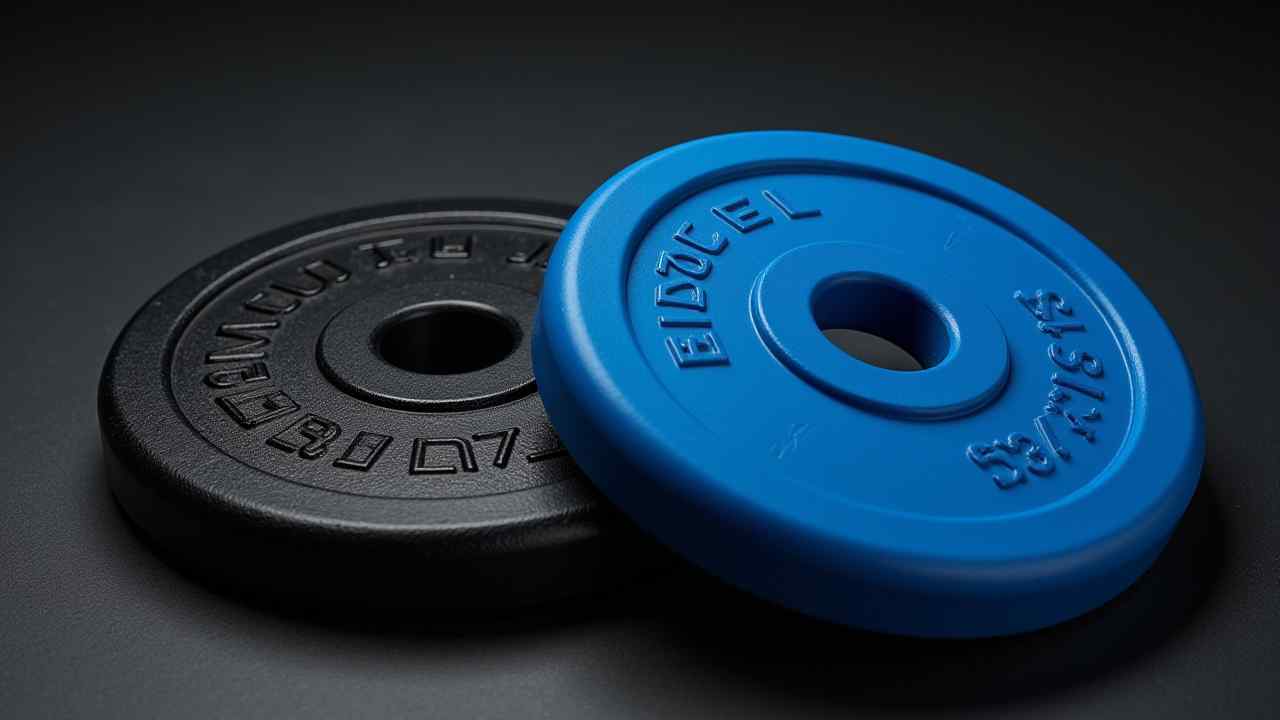
This is a "pro-level" confusion. The "45lb" system is American. (Imperial units). ( The rest of the world... ...(and the Olympics)... ...uses Kilograms (kg). The "real" 45lb plate... ...is actually a 20 Kilogram plate. (Or 20.4kg). ( The "real" Olympic bar... ...is a 20 Kilogram bar. (44.1 lbs). ( This is where the "colors" come from. The IWF (International) standard color... ...for a 20kg (44lb) plate... ...is BLUE. 🔵 And the color for a 25kg (55lb) plate... ...is RED. ❤️ This is why, in a "pro" gym... ...the 45lb plates are often BLUE. They are "mimicking" the 20kg standard. The Verdict: Does this 0.9 lb difference matter? No. Not for 99.9% of people. Just call it "45." It is the "gym-math" answer.
The 2 Types of 45lb Plates (Iron vs. Bumper) ⚖️
This is the "material" choice. It is a critical distinction. A 45lb plate is not just a 45lb plate. It has a job.
1. Cast Iron Plates (The "Classic") ⚙️
These are the old-school, classic plates. They are 100% solid cast iron. They are often black or gray. They are the "clang" of the gym. (Clang!). ( The #1 Pro: They are THIN. This is the most important advantage. This is why they exist. A 45lb iron plate is thin. (~1.25 inches). ( This means you can fit a lot of them... ...on a single barbell. This is for Powerlifters. A Powerlifter needs to squat 800+ lbs. They must use thin, iron plates. (You can fit 8-9 45s on each side!). ( The #1 Con: You CANNOT drop them. Ever. This is the #1 rule. If you drop an 800lb deadlift... ...(with iron plates)... ...you will break the plates. You will break the floor. And you will bend your 1,000 bar. Who are they for? Powerlifters. And bodybuilders. People doing slow, controlled lifts. (Squat, Bench Press). (
2. Bumper Plates (The "Modern" Plate) 🛡️
These are the modern standard. They are common in CrossFit. And in Olympic Weightlifting. They are made of a thick, dense rubber. (Or Urethane). (They have a steel "hub" in the middle. The #1 Pro: You CAN drop them! ✅ This is their entire purpose. They are made of rubber. They are designed to be dropped... ...from overhead. (After a Snatch or Clean & Jerk). ( They are quiet. (They "thud," they do not "clang"). ( They are safe for your floor. And safe for your bar. This is the #1 choice for a home or garage gym. The #1 Con: They are THICK. This is the main drawback. This is the "trade-off." A 45lb bumper plate is thick. (~3-4 inches). ( This means you cannot fit as many... ...on a single barbell. A standard barbell... ...might "max out" at 405 lbs. (That is four 45lb bumper plates per side). ( For 99% of humans, 405 lbs is more than enough. But for an elite Powerlifter, it is not. Who are they for? CrossFitters. Olympic Lifters. And Home Gym Owners. (Who want to protect their floor). (
The "Grips" vs. "No-Grips" Debate
This is a "sub-type" of the iron plate. You will see two types of 45lb iron plates. 1. The "Classic" Disc: This is the "old-school" plate. It is just a flat, solid, iron disc. Like a "manhole cover." It has no grips. It has no "holes." The Con: They are terrible to pick up. It is very hard to get your fingers under it. You can drop it on your toe. You can pinch your fingers. 2. The "Grip Plate": ✅ This is the "modern" iron plate. It is the one you see at Planet Fitness. It has 3 or 4 large holes in it. These holes are grips (handles). The Pro: They are 1000x safer and easier... ...to pick up. And to carry. And to load on the bar. They also unlock new exercises. You can use the 45lb plate by itself. (For a "Plate Halo," or a "Plate Lunge"). ( The Verdict: Always buy "Grip Plates" if you can. They are just better. (Unless you are a "powerlifting purist"). (
Safety & Etiquette (The Gym Rules)
This is a vital part of using "45 pound plates." You must be safe. And you must be respectful.
Rule 1: ALWAYS Use Clips / Collars 🔒
This is a 100% non-negotiable safety rule. A "clip" or "collar" is the tool... ...that slides onto the sleeve after the plate. It locks the plate in place. You MUST use clips. Always. On every set. Why? Weight plates move. They "walk" off the bar. If one 45lb plate slides off... ...the bar becomes unbalanced (135 lbs vs 45 lbs). The bar will flip. Violently. This is how serious injuries happen. A 400 lb bar-flip is a disaster. A 2-second clip prevents this. Do not be lazy. Use your clips.
Rule 2: Load the Bar Evenly (The "Big Plates First" Rule)
This is common sense. Do not load all the weight on one side. And there is an order. You must load the biggest plates first. The 45lb plates always go on first. (They are "closest" to the center). ( Then the 25s. Then the 10s. Then the 5s. Then the 2.5s. This is the "stable" way to load a bar.
Rule 3: Re-Rack Your Weights! (The Golden Rule) ✨
This is the most important rule of the gym. It is the "Golden Rule" of lifting. You MUST put your weights away. Do not be that person. The person who leaves 405 lbs on the bar. (That is eight 45lb plates!). ( It is lazy. It is selfish. It is dangerous. The next person may not be strong enough. They may not be able to remove your 45s. You are "claiming" that equipment. Even after you are gone. It is a sign of a bad, disrespectful lifter. A true lifter is clean. A true lifter is respectful. If you are strong enough to load the 45s... ...you are strong enough to unload them. Put your weights back. Put the 45s in the "45" slot. Be a professional.
Conclusion: The "Unit" of Strength
The 45-pound weight plate is the king. It is the "unit of strength" in the gym. It is the "standard" for all "gym math." (135, 225, 315). ( But not all 45s are the same. You must know the system. The 3 Golden Rules: 1. Choose the Olympic (2-inch) system. Always. Do not buy 1-inch "Standard" plates. It is a dead-end system. 2. Choose your material. Bumper Plates (Rubber) are for dropping. (CrossFit, Oly, Home Gyms). (Cast Iron (Metal) is for not dropping. (Powerlifting, Bodybuilding). ( 3. Be safe. Use clips. And be respectful. Re-rack your 45s. Now you know the system. Go lift something heavy. And be safe. 🌟