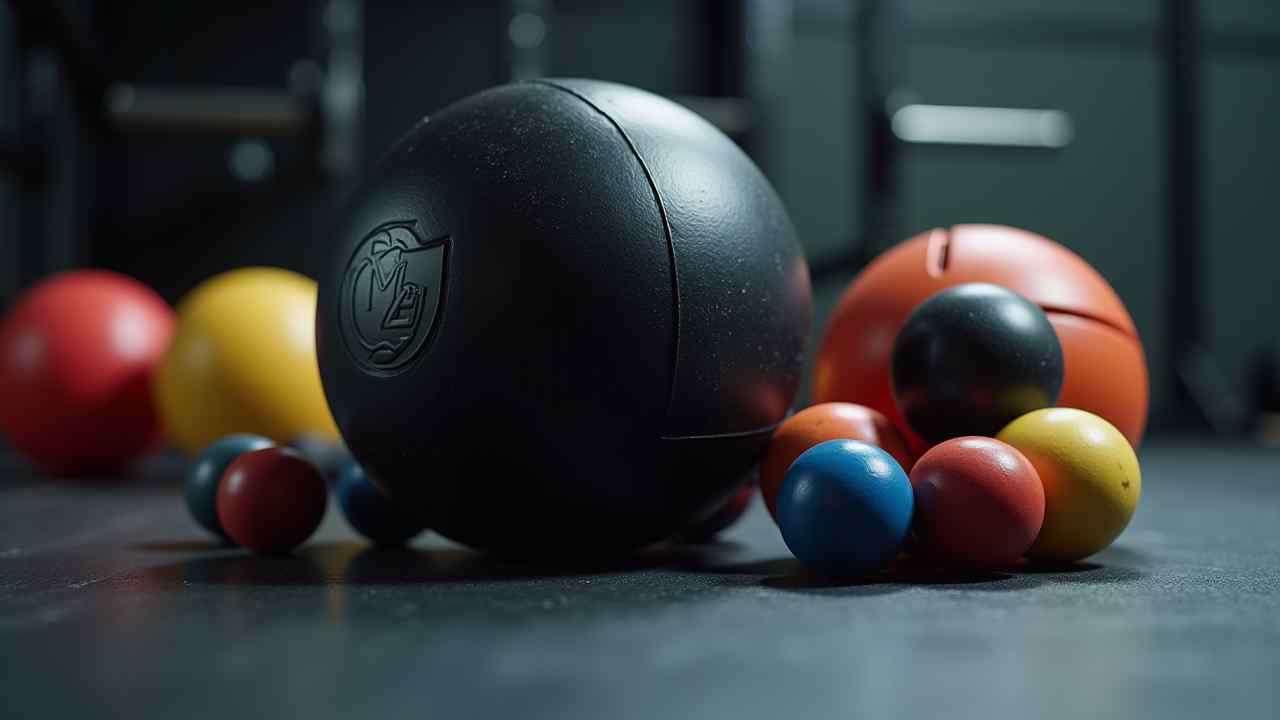
Weighted Balls Guide 🏋️ (All Types)
What is a "Weighted Ball"?
A "weighted ball" is a very broad term. It is a huge category of fitness tools. It is a ball that has weight. Simple! But this is a confusing category. The "job" of a 2-pound ball... ...is 100% different from a 20-pound ball. You must get the right tool for the job. This is not an "isolation" tool. (Like a dumbbell for your bicep). (It is a "functional" tool. It is an "integration" tool. IIt teaches your entire body to work as one unit. Legs, core, back, and arms. They all fire at once. TThis guide will explain the two main families. The "Big Balls" (for Power). And the "Small Balls" (for Toning).
Type 1: The "Big" Power Balls (Med, Slam, & Wall) 💥
This is the most common type. This is the "classic" medicine ball. It is for "dynamic" exercise. Dynamic means "power" and "speed." These balls are for throwing, slamming, and twisting. TBut there are 3 types. And they have opposite features. Buying the wrong one is a disaster.
The Critical Difference (The #1 Mistake!) 🚫
This is the most important part of this guide. You must know this.
1. The "Classic" Medicine Ball (The Bouncy One) 🏀
This is the old-school, traditional ball. It is often made of firm rubber. (Like a heavy, textured basketball). ( It may have handles. It is firm to the touch. Its #1 key feature: It bounces. Pros: Great for partner throws. Great for throwing against a solid wall. (It will bounce back to you). ( Cons: You CANNOT slam this ball. I repeat: DO NOT SLAM THIS BALL. If you slam it on the ground, it will bounce. It will bounce back up with 100% of your force. It will hit you directly in the face. This is a "broken nose" machine. Do not slam it. Best for: Weighted Russian Twists. Partner Passes. Squat-to-Overhead-Throws.
2. The "Slam Ball" (The "Dead" Ball) ☠️
This is the modern, popular ball. It is often black. It has a thick, soft, rubbery shell. It is filled with sand or gel. Its #1 key feature: It does NOT bounce. It is a "dead" ball. Pros: It is designed to be slammed. This is its entire purpose. You can (and should) throw this ball... ...as hard as you can... ...at the ground or a wall. It will "thud" and stop. It will not rebound. It is 100% safe for slams. This is the ball you want for a HIIT workout. Cons: It does not bounce. So, you cannot use it for "rebound" throws. Or fast partner passes. You must pick it up every time. Best for: Ball Slams. Rotational Throws. Powerful, explosive training. This is the most versatile, safest ball for 90% of people.
3. The "Wall Ball" (The "Soft" Ball) 🎯
This is the "CrossFit" ball. It is a large, soft, stitched ball. It is usually 14 or 20 inches wide. It looks like a big, leather or vinyl pillow. Pros: It is only for throwing. Specifically, for throwing at a wall. The "Wall Ball Shot" is a classic CrossFit move. The soft shell is safe to catch. If it falls on your head, it will not injure you. It is perfect for high-rep workouts. Cons: You CANNOT slam this ball! It is not a slam ball. You will bust the seams. The stuffing will explode everywhere. It is an expensive, one-trick pony. Best for: Wall Ball Shots. That is it.
Type 2: The "Small" Toning Balls (Pilates/Rehab) 🧘
This is the other category of "weighted ball." These are not for power. They are for endurance and control. These are small, "softball-sized" balls. They are "squishy." They are filled with sand. They are very light (1 lb, 2 lbs, 3 lbs).
What is the Point of a 2lb Ball?
A 2lb ball is not for building big muscle. ("Hypertrophy"). (It is too light. Its job is to add micro-resistance. It is for high-rep, slow, controlled movements. It is a "hands-free" weight. You "palm" the ball. You do not have to "grip" it. This is easier on your wrists. It targets your small stabilizer muscles. (In your shoulder and core). (This builds endurance, not size.
Who Uses Small Toning Balls?
1. Pilates & Barre (The #1 Use): This is the #1 use. They are perfect for a Pilates mat class. You hold them while doing "arm circles." Or "pulses." A 2lb ball will be screaming after 60 seconds. It is a serious "endurance" burn. 2. Physical Therapy & Rehab: 🩹 This is the other main use. It is for "pre-hab." (e.g., Rotator cuff exercises). (The 1-2lb load is perfect for healing... ...small, delicate joints. It is a safe, controlled way to add load. 3. Yoga: Some yoga classes use them. (e.g., holding them during a Warrior II). (It adds a new "endurance" challenge... ...to your shoulders.
The "Danger" of Small Balls 🚫
This is the same risk as wrist weights. Do NOT use these for fast, ballistic moves. (e.g., Cardio Kickboxing, or running). ( A 2lb ball is not "light"... ...when you add "momentum." The force can be 20-30 lbs. This "ballistic force" will shred your small joints. (Elbow, shoulder, wrist). ( These are "slow-mo" tools. Not "fast" tools.
The 5 Best "Big Ball" Exercises (Power!) 🔥
This is the "power" toolkit. These are the 5 best moves. Add 1 or 2 of these to your workout.
1. The Ball Slam (The King) 👑
This is the #1 power move. It is a full-body explosion. Muscles: Full Body! (Lats, Core, Shoulders, Glutes, Quads). ( How to Do It: 1. Get a Slam Ball (the non-bouncy one). 2. Stand tall. Feet are shoulder-width. Hold the ball at your chest. 3. Raise the ball high over your head. Rise up onto your toes. Get as "long" as you can. Breathe in. 4. In one, violent, explosive motion... ...SLAM the ball down. Hard. As hard as you can. Exhale hard ("TSSS!"). 5. Hinge at your hips. (Flat back!). (Use your lats and abs to pull the ball down. Do not just "throw" it with your arms. Do not round your back. 6. Slam it right between your feet. Try to break the ball. (You won't). ( 7. Squat down to pick it up. (Good form! Chest up, flat back). (Stand up. Repeat. This is the #1 power and cardio move.
2. The Rotational Throw (The "Twist") 🌪️
This is the #1 core power move. It is for rotational athletes. (Golf, baseball, tennis). ( Muscles: Obliques (side abs) and Hips. This is pure rotational power. How to Do It: 1. Use a Slam Ball or a Classic Med Ball. You need a solid brick or concrete wall. Do not do this at a normal gym wall! You will break the drywall. 2. Stand sideways to the wall. (About 3-4 feet away). ( 3. Hold the ball at your "back" hip. (The hip away from the wall). ( 4. In one explosive, rotational "twist"... ...throw the ball at the wall. As hard as you can. 5. Pivot your back foot. Use your hips to power the throw. Like a baseball bat swing. 6. Catch the ball on the rebound. (Or pick it up). (Absorb the catch. Repeat for 10 reps. Then switch sides.
3. The Weighted Russian Twist (The "Ab" Move)
This is a classic "six-pack" exercise. It is for core strength. It is not for power. So, go slow. Muscles: Obliques and Rectus Abdominis (six-pack). How to Do It: 1. Use a Classic Med Ball. (The bouncy one is easier to hold). ( 2. Sit on the floor. Lean back 45 degrees. Keep your back straight. (Not rounded!). ( 3. Lift your feet off the floor. (This is the hard version). (Keep them on the floor for an easier version. ( 4. Hold the med ball at your chest. 5. Twist your torso. Twist your shoulders. Tap the ball to the floor on your right. 6. Slowly, control the twist... ...all the way back. Tap the ball to the floor on your left. The Mistake: Do not just "wave" the ball with your arms! 🚫 That does nothing. Your arms should be "locked" to your chest. The twist must come from your torso.
4. The Squat-to-Overhead-Press
This is a full-body "functional" move. It is a classic fat-burner. Muscles: Legs (Quads/Glutes) and Shoulders. How to Do It: 1. Use a Classic Med Ball or Wall Ball. 2. Hold the ball at your chest. (Like a Goblet Squat). (Keep your elbows in. 3. Perform a full, deep squat. (Hips below knees, chest up). ( 4. Explode up! Stand up with power. 5. As you stand, use that momentum... ...to press the ball over your head. (Like a "thruster"). ( 6. Lock your arms out. Lower the ball safely back to your chest. Squat again. Repeat.
5. The "Wall Ball Shot" (The CrossFit Move) 🎯
This is a legendary conditioning exercise. It is a cardio nightmare. It is amazing. Muscles: Legs, Glutes, Shoulders, and Lungs. This is a full-body test. How to Do It: 1. Use a Wall Ball (the soft, stitched one). And a tall, solid wall. 2. Stand at the wall. Hold the ball at your chest. 3. Do a full, deep squat. (Ass-to-grass). ( 4. Explode up from the squat. 5. Use your leg power... ...to throw the ball up at a target. (Usually a 9 or 10-foot target). ( 6. Catch the ball as it falls. (Be careful!). ( 7. Smoothly absorb the catch... ...right into your next squat. This is a fluid, non-stop motion. Goal: Try to do 50. You will be exhausted.
The 3 Best "Small Ball" Exercises (Toning) 🧘
This is the "toning" toolkit. These are slow, controlled, and high-rep.
1. Pilates Arm Circles
How: Stand or sit tall. Hold a 1-2lb ball in each hand. Palms are down. Hold your arms straight out (a "T" pose). Now, make tiny circles. (The size of a dinner plate). (Go forward for 30 seconds. Then go backward for 30 seconds. Your shoulders will be on fire.
2. Standing Core Twist
How: Stand tall. Hold a 3-5lb ball in both hands. Lock your arms straight out. Glue them to your chest. Keep your hips forward. Slowly, twist your torso... ...to the right. (As far as you can). (Squeeze your obliques. Hold. Slowly return to center. Slowly twist to the left. SThis is a great, safe, rotational core-builder.
3. Glute Bridge Squeeze
How: Lie on your back. Bend your knees. Place your feet on the floor. Place a 3-5lb ball between your knees. Now, perform a glute bridge. (Lift your hips). (But as you lift... ...SQUEEZE the ball with your knees. Squeeze hard! This forces your inner thighs (adductors) to work. It is a 2-in-1 move for glutes and thighs.
How to Choose Your Weight (The #1 Mistake) ⚠️
This is the #1 beginner mistake. Ego. You are a strong person. You deadlift 300 lbs. So you grab a 50 lb slam ball. This is wrong. And it is dangerous. For Big Balls (Slams): Power is about SPEED. Not just weight. If the ball is too heavy... ...you cannot move it fast. You are not training "power" anymore. You are just doing a "slow, ugly deadlift." You will also get tired. Your form will break. And you will injure your lower back. This is a very common injury. The Rule: Start light! Start with a 10 lb, 15 lb, or 20 lb ball. Maximum. Focus on speed and violence. Not on the number. A 15-lb slam, done with 100% force... ...is 1000x better than a 50-lb "mushy" lift. ... For Small Balls (Toning): Do not grab the 5lb ball. Start with the 1lb or 2lb balls. Trust the process. It will be brutal after 60 seconds of arm circles. If it is easy, your form is wrong. (You are moving too fast). (
Conclusion: The Right Ball for the Right Job
A "weighted ball" is not one tool. It is a whole toolbox. You must match the ball to the goal. This is the only rule. Choose a "Big" Power Ball (10-30 lbs) if:
- You want explosive power. 💥
- You want HIIT cardio.
- You want a full-body, functional workout.
- (Get a Slam Ball (no-bounce) for 90% of uses).
- You are doing Pilates or Barre. 🧘
- You are in Physical Therapy / Rehab. 🩹
- You want slow, controlled, high-rep endurance.