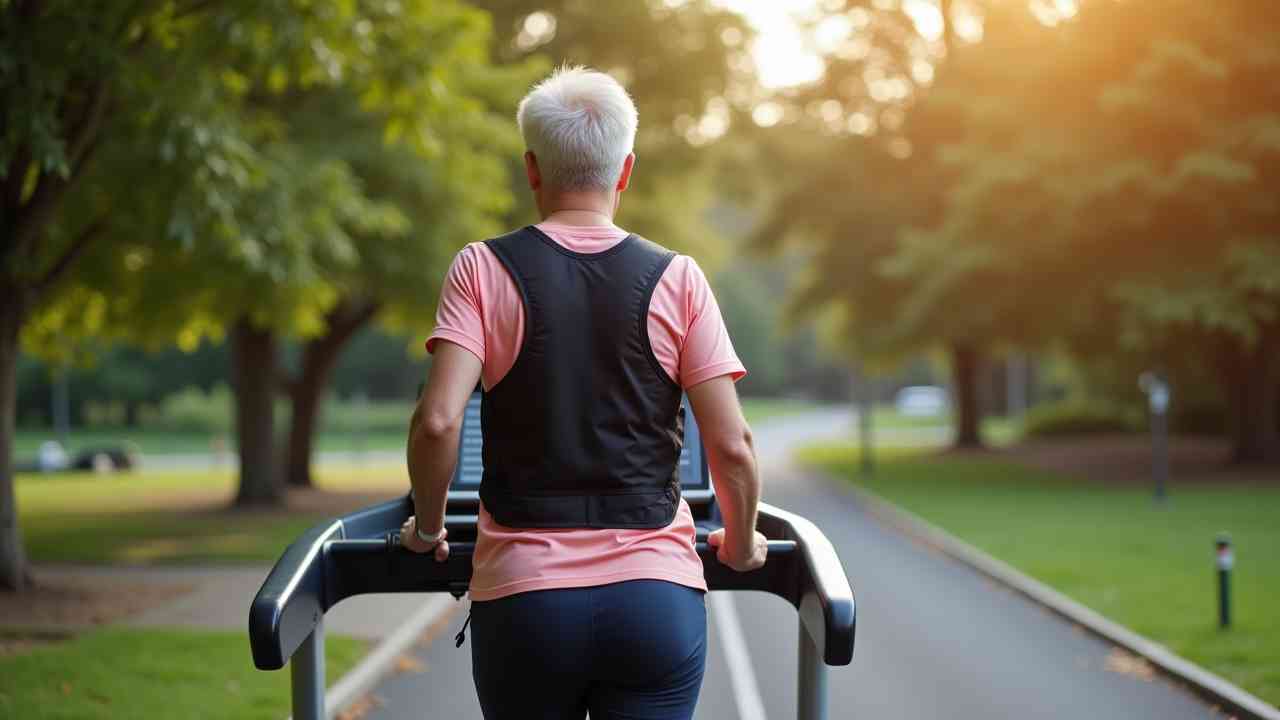
Weighted Vest & Osteoporosis 🦴
What is Osteoporosis?
Osteoporosis is a common bone disease. 🦴 It means "porous bone." Your bones lose density. They get weak. They get brittle. They are full of tiny "holes." This makes them very easy to break. A simple fall can be a disaster. A simple cough can break a rib. This is a serious medical condition.
What is a Weighted Vest?
A weighted vest is a piece of gym gear. 🏋️ It is a vest you wear. It is filled with small weights. (e.g., sandbags or metal plates). ( It adds an "external load" to your body. It makes you heavier. The question is: Can this tool help osteoporosis? Can it make your bones stronger? The answer is YES. But it is also VERY DANGEROUS. This is a high-risk, high-reward tool. You must understand the risks. You must be 100% safe.
CRITICAL WARNING: This is a Medical Tool 🚨
This is the most important part of this guide. Read this first. This is NOT medical advice. 🚫 You are a person with osteoporosis. Your bones are fragile. What happens if you (a fragile person)... ...suddenly add 20 pounds of weight? And you jump, or run, or fall? You could get a vertebral compression fracture. (A spinal fracture). ( This is a 911-level emergency. It is the opposite of your goal. You MUST talk to your doctor first. 🩺 You must get a DEXA scan. (A bone density scan). ( Your doctor must clear you for this. They must agree you are safe to start. Do not do this alone. Do not self-prescribe this. It is a medical device. Treat it with respect.
The Science: How Does This Even Work? (Wolff's Law)
So, why would this work? How can "stress" be good? The answer is Wolff's Law. This is a medical principle from 1892. It is the key to bone health. Wolff's Law states: Bone will adapt to the loads placed upon it. This means your bones are alive. They are not dead sticks. They are "dynamic tissue." They are always remodeling. If you place no load on a bone... ...(e.g., you are an astronaut in zero-g)... ...your body says: "We don't need this bone!" It removes bone density. This is "atrophy." If you place a high load on a bone... ...(e.g., you are a powerlifter)... ...your body says: "We are under attack! Send reinforcements!" It sends "builder" cells (osteoblasts). These cells build new, stronger, denser bone. This is "hypertrophy." A weighted vest is a simple "load" signal. It adds 10 pounds of "load" to your spine. And to your hips. Your body senses this new, constant load. It responds by building stronger bones. This is the theory. And it works.
The "Pros": 4 Benefits of a Weighted Vest
When used safely, the benefits are huge.
1. Builds Bone Mineral Density (BMD) 🦴
This is the #1 goal. The vest adds "axial loading." (Load on your spine). ( This directly stresses your vertebrae. And your hip (femoral neck). These are the two most dangerous fracture sites. A hip fracture is a life-changing event. The vest is a direct way to strengthen them.
2. Builds Muscle Strength (Your "Armor") 💪
Your muscles are your "body armor." They are your "shock absorbers." When you wear a 10lb vest... ...your legs, glutes, and core must work 10% harder. They must work harder just to stand up. And to walk. This builds lean muscle mass. Muscle is also the "organ of longevity." A strong body is a safe body.
3. Improves Balance & Posture
This is a critical, overlooked benefit. The vest pulls on you. It forces your postural muscles to fire. It makes you stand up straight. It also acts as a "balance challenge." Your body's center of gravity is higher. Your "stabilizer" muscles must work harder. This improves your balance. What does good balance prevent? FALLS.
4. It Reduces Your Fall Risk (The Real Goal) 🎯
This is the real, final goal. Osteoporosis is bad. But a fall is the catastrophe. A fall is the event that causes the fracture. A weighted vest makes you stronger. And it makes you more balanced. A stronger, more-balanced person... ...is much less likely to fall. They can "catch" themselves. This is the ultimate prevention. Prevent the fall. Prevent the fracture.
The "Cons": The 4 HUGE Dangers 🚨
This is the other side. This is the dangerous side. You must respect these risks.
1. Risk of Spinal Fracture 🤕
I must say this again. This is the #1 risk. Your vertebrae are "porous." They are like brittle chalk. If you add too much weight, too soon... ...the vertebra can collapse on itself. This is a "compression fracture." This is why you must START LIGHT. (1-2 lbs). (And you must NEVER JUMP.
2. Joint Pain (Knees & Hips)
You are adding 10-20 lbs of load. Where does this load go? Right into your joints. Your hips. Your knees. Your ankles. If you have arthritis and osteoporosis... ...this can be a bad combo. The extra weight can cause joint pain. This is why you must start light. And you must stop if you feel any joint pain.
3. The "Running" Mistake 🚫
This is a critical error. Do not do this. You must NEVER RUN with a weighted vest. Especially with osteoporosis. Running is a high-impact sport. Every step is a small "jump." The "impact" force is 3-4x your body weight. Now you have added 20 lbs. You are sending a shockwave... ...through your fragile joints and spine. You are begging for a stress fracture. The vest is for WALKING ONLY. 🚶♀️
4. Posture Problems (Bad Fit)
If the vest fits poorly, it is a problem. If it is too loose, it will "bounce." This is a jarring, unsafe force. If it is too "forward," it will pull your shoulders. It will make your posture worse. It can cause back pain. The vest must fit perfectly. (See the next section). (
Who Should NOT Use a Weighted Vest? 🚫
This tool is not for everyone. Do not use this vest if you have:
- Severe Osteoporosis: If your T-Score (from your DEXA) is very low. (e.g., -3.0 or lower). (The risk of fracture is just too high. Y
- Kyphosis (A "Hunchback"): A severe forward curve of the spine. The vest will make this worse. T
- Existing Spinal Fractures: Do not add load to a broken bone. D
- Poor Balance: If you are already "unsteady" on your feet... ...adding weight will make you more unstable. It will increase your fall risk. Do not use it. D
- Active Joint Pain: If your knees or back hurt, do not add weight. Fix the pain first. F
How to Choose the Right Vest (The "Safe" Vest)
You have been cleared by your doctor. You are ready to buy. Great. You must buy a specific kind of vest. Not the "CrossFit" kind.
1. It MUST Be Adjustable. In Small Steps.
This is the #1 feature. Do not buy a "Fixed 20 lb" vest. It is useless and dangerous. You need a vest that is adjustable. You must be able to change the weight. And the steps must be small. Look for a vest with 0.5 lb (half-pound) or 1 lb increments. This is the only safe way to progress.
2. It MUST Be Snug. (The Fit). 🔑
The fit is critical. You want a vest that is snug to your torso. Like a tight hug. It must not bounce. It must not shift. It should feel like "part of you." Look for vests with adjustable Velcro straps. Cinch it down. It should not move when you walk.
3. The Weight Distribution
The weight should be high on your torso. On your chest and upper back. It should not be low, on your stomach. Or on your lower back. This is a bad center of gravity. It will pull on your lumbar spine. A good vest feels "balanced."
How to Use a Weighted Vest Safely (The 5-Step Plan)
This is your safety protocol. Follow these rules. No exceptions.
Step 1. Get Your Doctor's Clearance 🩺
I will say it one last time. Go to your doctor. Get your DEXA scan. Ask them: "Am I safe to start a walking program with a 1-pound weighted vest?" Get their "Yes."
Step 2. The Exercise: WALKING ONLY. 🚶♀️
Your new exercise is walking. (Or "rucking"). ( That is it. No running. No jumping. No burpees. No plyometrics. No exceptions. You will wear the vest... ...while you go on your daily 30-60 minute walk. This is a low-impact, safe, repetitive "loading" event. This is perfect.
Step 3. The Weight: START WITH 1 POUND.
Yes, one pound. It feels "stupid." It feels "too light." It is not. Your bones are fragile. We must introduce the signal. We do not know how your body will react. Start with 1 lb (or just the vest itself). Walk with that for one full week. How do you feel? No pain? Great.
Step 4. The Progression: SLOW. (Snail's Pace) 🐢
This is where people fail. They get impatient. Don't. You must progress at a snail's pace. The Rule: Add 1 pound per month. (Or per 2-4 weeks, at most). ( Yes, per month. This is not a typo. Bone remodeling is a slow process. It takes months and years. This is a marathon. Week 1-4: 1 pound. Week 5-8: 2 pounds. Week 9-12: 3 pounds. This is the safe, sustainable, injury-free way to build density. It gives your body time to adapt.
Step 5. The "Cap": 10 Pounds is a GREAT Goal.
What is the "end goal"? Do not aim for 50 pounds. That is for soldiers. A great, safe, effective goal... ...is 10 to 15 pounds. (Or 5-10% of your body weight). ( Walking for 45 minutes with a 10-15 lb vest... ...is a fantastic bone-building signal. It is a fantastic muscle-builder. And it is a fantastic cardio workout. There is no need to go heavier. The risk is not worth it. Consistency is the goal. Not weight.
The "Gold Standard": Real Strength Training 🏋️
A weighted vest is a "passive" load. It is a great tool. But what is the best way to build bone? The #1 way? It is real strength training. (With barbells and dumbbells). ( This is "active" loading. The muscles are the key. When you do a heavy squat... ...your leg and glute muscles... ...pull on your hip bones. This "pull" (tension) is a powerful signal. It tells the bone to get stronger. This is the #1 way to build bone. The Best Bone-Building Exercises:
- Squats
- Deadlifts (This is the hip-builder!)
- Overhead Press
- Lunges
- Farmer's Carries (This is a "vest" in your hands!)
Conclusion: A Tool for the Patient
A weighted vest is a good tool for osteoporosis. But it is a dangerous one. It is a sharp knife. In the hands of a surgeon, it saves a life. In the hands of a child, it is a disaster. You must be the surgeon. You must be patient. You must be smart. Your 3 Golden Rules: 1. Doctor First. 🩺 Get your DEXA scan. Get their permission. Non-negotiable. 2. Walk. Don't Run. 🚶♀️ This is a low-impact tool. Use it for walking only. Running is a fracture risk. 3. Start Light. Go SLOW. 🐢 Start with 1-2 pounds. Add 1 pound per month. Be patient. Your bones will thank you. This is not a fast fix. This is a lifelong commitment. But it is a powerful one. You can take control of your bone health. You can get stronger. You can be safer. 🌟