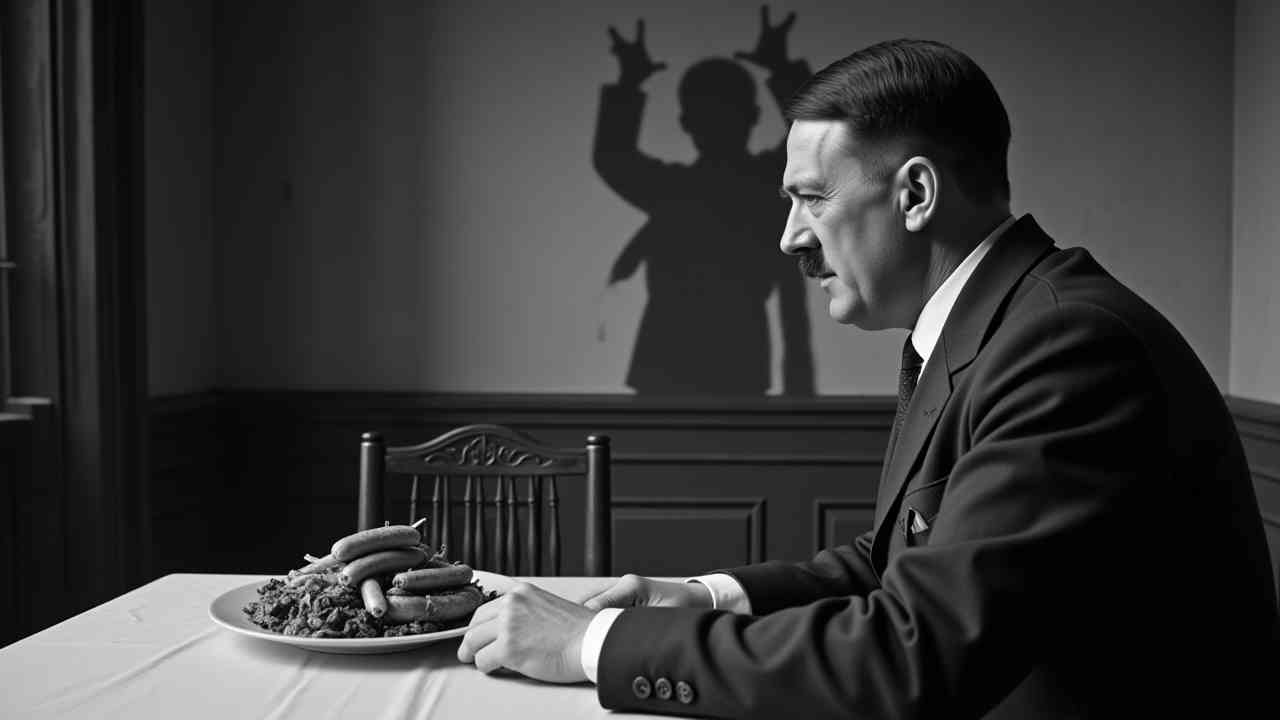
Was Hitler a Vegetarian? The Complicated Truth 🥩🤔
Introduction: The Enduring Historical Question
Was Adolf Hitler a vegetarian? This is one of history's most persistent questions. It is a detail that seems both trivial and profound. 🧐 The image of the 20th century's worst tyrant is complex. The idea of him being an ethical vegetarian is a paradox. How could a man who loved animals murder millions of people? This is the core of the fascination. The simple answer to this question is not "yes" or "no." The truth is a complex tangle of three things. 📜 First, there was powerful Nazi propaganda. Second, there was Hitler's failing personal health. Third, there are many conflicting historical reports. This article will explore all sides of the story. We will separate the historical facts from the propaganda myth.
The Public Image: Hitler the Ascetic
Adolf Hitler's public image was vital. It was crafted with extreme care. 🧑🎨 He was presented to the German people as an ascetic leader. This means he lived a life of strict self-denial. He was portrayed as pure and almost superhuman. This image was a powerful tool for the Nazi party. It made him seem different from other politicians. He was above personal pleasure. He sacrificed everything for the German nation. This public image had clear components. He did not smoke cigarettes. 🚭 He did not drink alcohol. 🚫 He reportedly had no interest in personal wealth. And most famously, he did not eat meat. 🥦 He was, in the public's eye, a vegetarian. This image was crucial for his propaganda machine. It built a myth of a pure, focused Führer.
The Role of Propaganda Minister Joseph Goebbels
This image was no accident. It was heavily promoted by his propaganda minister, Joseph Goebbels. Goebbels was a master of public relations. He understood the power of a simple story. He wanted Hitler to seem pure and morally superior. He contrasted Hitler with the corrupt leaders of the Weimar Republic. He also contrasted him with indulgent foreign leaders. Even within the Nazi party, Hitler seemed different. Hermann Göring, for example, was famously gluttonous. Göring hosted lavish parties and hunts. Hitler seemed to be the opposite. He was a man of simple tastes. 🍎 Goebbels wrote about this strategy in his diaries. He noted Hitler's vegetarianism as a key talking point. He saw its power to build a cult of personality. It made Hitler seem gentle and controlled.
The Animal Welfare Argument
The propaganda also linked this diet to Hitler's love for animals. This was a key part of the paradox. Hitler was famously devoted to his German Shepherd, Blondi. 🐕 He was often photographed with her. This presented a softer, more human side. The Nazi regime also enacted animal welfare laws. In 1933, they passed some of the world's strictest laws. These laws banned practices like vivisection (animal experimentation). This created a supporting narrative. How could a man who loved animals so much possibly eat them? This image was very effective. It made him seem compassionate to many Germans. It was a useful mask for his brutality.
The Conflicting Evidence: What Witnesses Said
The historical record is much less clear. The "strict vegetarian" claim is heavily disputed. Many close personal accounts contradict the propaganda. 🤫 These reports come from his cooks, his secretaries, and his biographers. They paint a much more complicated picture. They suggest Hitler's diet was a matter of preference and health, not ethics.
Reports of Meat Consumption
Several sources claim Hitler ate meat throughout his life. Robert Payne was a prominent biographer of Hitler. In his 1973 book, The Life and Death of Adolf Hitler, he disputed the myth. Payne claimed Hitler's diet was not strict at all. He stated Hitler had a fondness for certain meats. These reportedly included Bavarian sausages. 🌭 He also reportedly enjoyed Leberknödel (liver dumplings). These are a common German specialty. This directly contradicts the idea of a strict vegetarian. Dione Lucas was a German cook. She worked at a Hamburg hotel in the 1930s. She later became a famous TV chef in America. In her 1964 cookbook, The Gourmet Cooking School Cookbook, she made a bold claim. She stated she had often prepared Hitler's favorite dish. His favorite dish, she claimed, was stuffed squab (young pigeon). 🕊️ She wrote, "I do not mean to spoil your appetite for stuffed squab... But you may be interested to know that it was a great favorite with Mr. Hitler." This is a very specific, first-hand account. It comes from a professional chef. Her claim is one of the strongest pieces of evidence against the vegetarian myth. Historians like Ian Kershaw have referenced these accounts. They conclude the vegetarian claim is a myth.
Accounts from the Inner Circle
The evidence from his closest staff is also mixed. This is where the confusion deepens. Different people saw different things. Traudl Junge was Hitler's last private secretary. She worked with him in the final, intense years of the war. She was in the bunker with him until the very end. Junge maintained in her memoirs that Hitler was a vegetarian. She said he ate mostly vegetables, soups, and grains. She wrote that he would often lecture his staff about the "evils" of meat-eating. However, her experience was mostly from 1942 to 1945. By this time, Hitler's health was failing. His diet was extremely bland and restrictive. Her account may be true for that period. But it may not reflect his entire life. Other accounts are less certain. Albert Speer, his architect, wrote about dinners. He said Hitler would sometimes eat ham or sausages. He would then feel guilty or sick afterward. This suggests a man who was not strictly vegetarian. He was perhaps a "flexitarian" who struggled with his diet.
The Health Argument: A Compromised Gut
This is the most likely and logical explanation. It reconciles all the conflicting stories. Hitler's avoidance of meat was probably not for ethics. It was almost certainly for his health. He was, by all accounts, a very sick man. He suffered from severe, chronic digestive problems. 🤢 This is documented by multiple sources. His doctors' notes are very clear on this.
Chronic Flatulence and Stomach Pain
Hitler suffered from extreme, uncontrollable flatulence. 💨 This was a source of great personal embarrassment. He also had intense stomach cramps and spasms. He constantly complained of a "burning" stomach and indigestion. He likely tried many diets to fix this. He believed that eating meat made these conditions worse. Heavy, fatty meats can be difficult to digest. He probably found that a simpler, plant-based diet was easier on his gut. So, he chose to avoid meat most of the time. This was a practical health decision. 🥦 It was a form of self-medication for his chronic pain. This explains why he might eat meat (like squab) on occasion. He would then suffer the consequences later. This fits Speer's account of him feeling sick after.
The Bizarre Treatments of Dr. Morell
His personal physician was Dr. Theodor Morell. Morell was a quack. He treated Hitler's digestive issues aggressively. He prescribed a cocktail of over 80 different drugs and injections. 💉 Hitler's diet became increasingly bland to manage his pain. He ate mashed potatoes, broth, and simple cooked vegetables. He was desperate for relief. Morell prescribed "Dr. Koester's Antigas Pills" for the flatulence. Hitler took 16 of these pills every day. In 1944, another doctor analyzed these pills. He found they contained strychnine. Strychnine is a poison. Hitler was being slowly poisoned by his own doctor. This likely worsened his stomach problems. Morell also gave Hitler injections. These included animal-based extracts. He injected processed animal hormones and placenta. This would violate any true ethical vegetarian code. This fact alone proves Hitler was not a strict vegetarian.
The Modern Definition: Was He Truly Vegetarian?
We must apply our modern definitions to the question. A "vegetarian" is a clear term today. A strict vegetarian is someone who never eats animal flesh (meat or fish). A vegan also excludes all animal byproducts. This includes dairy, eggs, and honey.
He Was Definitely Not Vegan
Hitler was 100% not a vegan. 🚫 All sources agree on this. He consumed eggs and dairy products. He was very fond of milk, cheese, and yogurt. 🧀 These were staples of his diet at the Berghof, his mountain retreat. So, the vegan question is easily answered. He was not one.
He Was Not a Strict Vegetarian
Based on the evidence, he was not a strict vegetarian either. The accounts of him eating sausages (Payne) are strong. The report of him eating stuffed squab (Lucas) is very specific. The injections of animal extracts (Morell) are documented. A true vegetarian does not eat meat. Hitler seems to have eaten meat, even if only occasionally. Therefore, he does not meet the modern definition. He was likely what we would now call a flexitarian. He ate a predominantly plant-based diet. He did this for health reasons, not ethical ones.
The Legacy of the Myth
Why does this myth persist so strongly? It is a powerful, emotionally charged paradox. How can a man who (allegedly) loved animals be a monster? This is known as "cognitive dissonance."
A Tool for Debate
The myth is often used as a weapon in debates. This is true on both sides of the vegetarian argument. Vegetarian groups have long fought this connection. They correctly argue he was not a true vegetarian. They point to his meat-eating. They note his lack of a true ethical stance. They do not want their movement associated with him. Conversely, some meat-eaters use the myth. They use it to "prove" that vegetarianism does not make you a good person. This is a logical fallacy, of course. A diet has no bearing on morality. The debate continues because it is so emotionally potent. It forces us to confront a difficult idea.
Separating Diet from Morality
Hitler's diet is ultimately a historical footnote. It has no bearing on his morality or his actions. His genocidal acts are the focus of history. His food preferences are irrelevant to his crimes. A person's diet does not define their character. You can be a meat-eater and a good person. You can be a vegetarian and a good person. The myth itself is a powerful study in propaganda. It shows how a public image can be manufactured. It can hide the truth of a flawed, sick individual. It can make a monster seem pure.
Conclusion: A Complicated and Contradictory Diet
So, was Hitler a vegetarian? No. Not in the strict, modern sense. 🚫 He was not a vegan. He ate eggs and dairy. He was not a strict vegetarian. He almost certainly ate meat on occasion. This included sausages, liver dumplings, and squab. He did follow a primarily plant-based diet. 🥦 He did this later in life. The reason was not for animals or ethics. It was for his own severe, chronic stomach problems. The image of the pure, ethical leader was a lie. It was one of many lies created by the Nazi regime. It was a masterful piece of propaganda. The reality was a sick man. He was wracked with pain and digestive issues. He ate what he could to manage his symptoms. The truth, as always, is far more complex than the myth. 💡