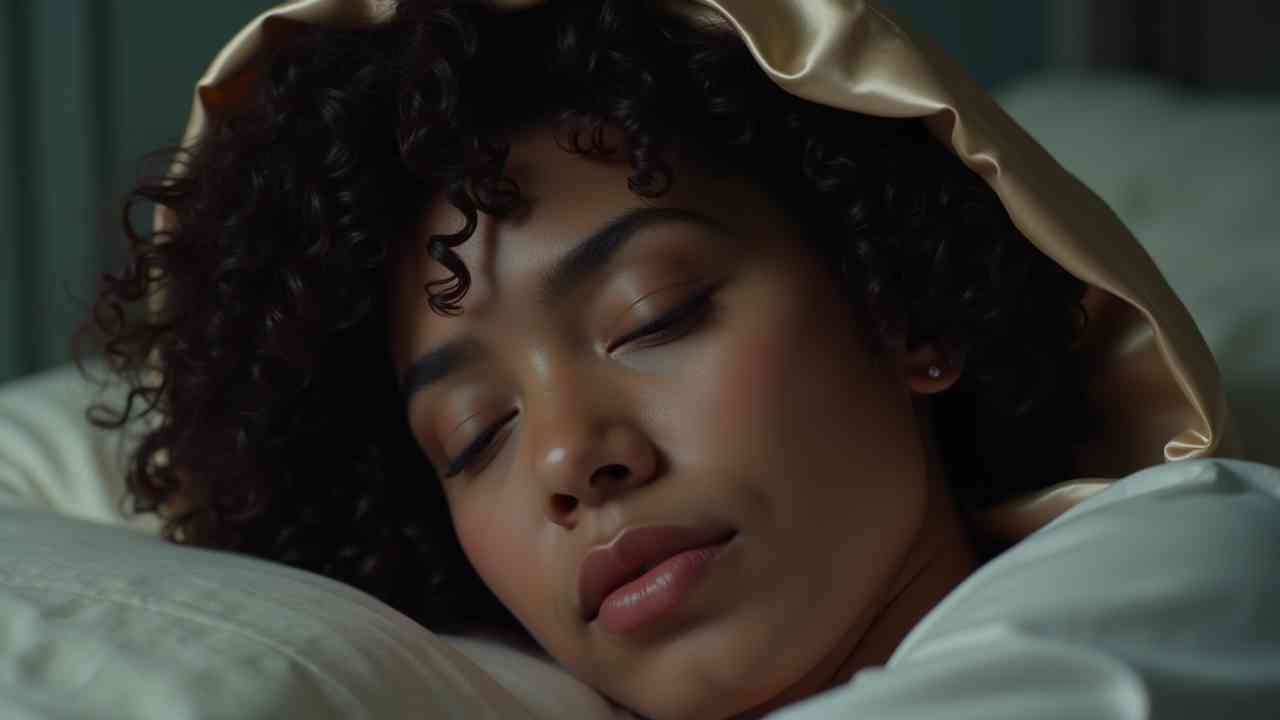
Sleeping in a Satin Bonnet: The Hair-Saving Secret 😴✨
What is a Satin Bonnet?
A satin bonnet is a simple, affordable hair accessory. It is a soft cap worn to bed. 🧢 Its purpose is to protect your hair while you sleep. This is a practice used for generations. It is a cornerstone of Black hair care. 👩🦱 But it offers huge benefits for all hair types. This guide explains why you need one. 💡
The Problem: How Sleep Damages Your Hair
You may think sleep is restful. But for your hair, it is an 8-hour battle. The enemy? Your pillowcase. pillow Most people sleep on cotton pillowcases. Cotton is the worst material for your hair. 👎
1. Cotton is Absorbent (The Moisture Thief)
Cotton is a hydrophilic (water-loving) fiber. It is designed to absorb moisture. That is why we use it for towels. When you sleep, it acts like a towel on your head. It sucks all the natural oils (sebum) from your hair. It also steals any leave-in conditioner or moisturizer you applied. This leaves your hair dry, brittle, and weak. 💧
2. Cotton Causes Friction (The Frizz-Maker)
Look at cotton fibers under a microscope. They are rough and uneven. When you toss and turn, your hair snags on these fibers. This friction roughs up your hair's outer layer (the cuticle). This snagging leads to three major problems:
- Frizz: A roughed-up cuticle is the definition of frizz.
- Tangles: Hair strands knot together.
- Breakage: The fragile strands snap under the tension.
The Solution: The 5 Benefits of a Satin Bonnet
A satin bonnet is the ultimate shield. ✨ It creates a barrier between your hair and the cotton. The benefits are immediate and dramatic.
Benefit 1: Frizz and Tangle Prevention
Satin is a smooth, low-friction surface. Your hair glides across the fabric. There is no snagging. The hair cuticle stays smooth and flat. You wake up with hair that is sleek. It is far more manageable. This saves you time on detangling. ⏰
Benefit 2: Moisture Retention
This is the most important health benefit. Satin is a non-absorbent material (hydrophobic). It does not steal your hair's moisture. The natural oils and products you use stay on your hair. 🧴 This keeps your hair hydrated all night long. Hydrated hair is elastic, strong, and healthy. It grows longer because it does not break.
Benefit 3: Hairstyle Preservation
A bonnet is an investment protector. 💰 Did you spend hours on a twist-out or braid-out? Did you pay for a professional silk press or blowout? Sleeping on cotton will destroy that style in one night. The bonnet contains and protects the style. Braids, locs, and twists are protected from friction. Curls and waves keep their definition and volume. Your hairstyle will last two or three times longer. 💃
Benefit 4: Breakage and Split End Prevention
Hair breakage is caused by dryness and friction. The satin bonnet solves both problems at once. By locking in moisture, your hair stays elastic. By reducing friction, your hair stops snagging. This means fewer split ends. You will see less breakage. You will find fewer "fairy knots" (single-strand knots). This is the real secret to retaining length. 📏
Benefit 5: Cleaner Skin and Pillows
This is a benefit no one talks about. Think about your hair products. Oils, gels, butters, and leave-in conditioners. 🥥 At night, these products transfer to your pillowcase. Then, you roll your face onto that pillow. 🤢 This can clog your pores. It often causes acne. This is known as "pomade acne." The bonnet acts as a barrier. 🛡️ It keeps your hair products on your hair. Your expensive pillowcases stay clean. Your skin stays clearer.
Who Should Wear a Satin Bonnet?
Satin bonnets are essential for Black hair care. They are a non-negotiable tool for protecting textured hair. But the benefits apply to everyone.
1. Curly and Coily Hair (Types 3-4)
This is the primary user. 👩🦱 The structure of curly hair makes it naturally drier. A bonnet is essential. It preserves the curl pattern. It prevents frizz and breakage.
2. Wavy Hair (Type 2)
Wavy hair is prone to frizz. A bonnet will keep your waves smooth. It preserves definition. You will wake up with beachy waves, not a puffy mess.
3. Straight Hair (Type 1)
Even straight hair benefits. A bonnet reduces tangles and knots. 👩 It prevents the "bed head" look. If you have a fresh blowout or silk press, a bonnet is a must. It keeps the hair sleek and straight.
4. Damaged or Color-Treated Hair
Bleached or colored hair is very fragile. The cuticle is already damaged. 🎨 Sleeping on cotton is like using a scrub brush on it. A bonnet protects these high-porosity strands. It prevents further split ends.
Satin vs. Silk: What's the Difference?
This is a common point of confusion. The two materials look similar. They provide the same function. But they are very different in origin and price.
Satin (The Standard)
Satin is not a fiber. It is a type of weave. 🧶 The weave is tight, smooth, and glossy on one side. Most satin bonnets are made from polyester. Polyester is a synthetic (plastic) fiber. Pros: Very smooth, low friction. Does not absorb moisture. Very durable. Very cheap. 💰 Cons: Not breathable. It can trap heat. This can make your head sweat.
Silk (The Luxury)
Silk is a natural protein fiber. 🐛 It is made by silkworms. It is the ultimate luxury material for hair. Pros: Perfectly smooth. Zero friction. It is a protein, so it is great for hair. Most importantly, it is highly breathable. It is a natural temperature regulator. It keeps you cool. ❄️ Cons: Very expensive. It is also very delicate. It must be hand-washed. 🧼
The Verdict: Which is Better?
For most people, a polyester satin bonnet is the perfect choice. It provides 95% of the hair-saving benefits of silk. It costs a fraction of the price. It is durable and easy to wash. A silk bonnet is a luxury upgrade. It is more comfortable if you get hot.
How to Choose the Perfect Satin Bonnet
You are ready to buy one. What do you look for? Fit and size are the most important features.
1. The Fit (The Band)
The bonnet must stay on all night. 😴 If it is too loose, it will fall off by 2 AM. This makes it useless. If it is too tight, it is painful. It will give you a headache. It will leave a deep mark on your forehead. Look for an adjustable band. 💡 Many bonnets now have a hidden toggle. Or they have a ribbon tie. This lets you customize the fit. This is the best feature to look for. Also, look for a wide, soft headband. A thin piece of elastic will be painful. A wide, fabric-covered band is much more comfortable.
2. The Size (The Cap)
The cap itself must be large enough. 👑 It needs to hold all your hair without crushing it. A small, tight bonnet will flatten your curls. This defeats the purpose. Extra-Large (XL) Bonnets: Get this if you have a lot of hair. This is for thick, high-density curls, afros, or braids. Long Bonnets: Get this if you have very long hair. Or if you have long locs or braids. These bonnets are shaped like a long tube. They allow your hair to hang down loosely. This protects the length without bunching it up.
3. The Lining (Double-Sided)
This is a pro-tip. 🔑 Make sure the bonnet is satin-lined. The inside is what matters. Some cheap bonnets are satin on the outside. But they are rough on the inside. This is a scam. It will damage your hair. Look for a double-lined or reversible bonnet. This means it is smooth satin on both the inside and the outside. This is a bonus. If your bonnet falls off, your hair lands on the smooth outer layer. Win-win.
How to Use Your Bonnet (The "Pineapple")
You have your bonnet. How do you put your hair in it? Do not just stuff your hair in randomly. For curly or wavy hair, use the "pineapple" method. 🍍 This method preserves volume at your roots. 1. Flip your head upside down. 2. Gather all your hair. Gather it at the very top of your head. (Your "forehead"). 3. Secure your hair with a loose scrunchie. Use a satin or silk scrunchie. Do not tie it tight. You are just "pineappling" it. 4. Now, flip your head back up. 5. Open your bonnet. Hook the elastic at the nape of your neck. 6. Stretch the bonnet up and over your head. Scoop your "pineapple" into the cap. 7. Pull the front of the bonnet to your hairline. 8. Tuck in any stray hairs. Adjust the band for comfort. When you wake up, take the bonnet off. Shake your curls out. The volume will be at the root, not the ends.
The Alternative: The Satin Pillowcase
What if you just hate wearing a cap? Some people cannot sleep with anything on their head. It feels hot. It feels constricting. For you, the answer is a satin or silk pillowcase. ✨ This is a fantastic alternative. It provides the same core benefits. It gives your hair (and your face!) a smooth, low-friction surface. Pros: It never falls off. It is more comfortable. It is also better for your skin. It can reduce sleep wrinkles and acne. Cons: Your hair is not contained. It will still move around. This can mess up a very defined style more than a bonnet would. Many people use both. A bonnet and a satin pillowcase. This is the ultimate, "belt-and-suspenders" protection. If your bonnet slips off, you have a safe landing. 🛬
Conclusion: The Easiest Upgrade for Your Hair
Sleeping in a satin bonnet is a simple change. It is one of the easiest and cheapest ways to improve your hair health. It is a non-negotiable tool for curly and coily hair. It is a smart upgrade for all hair types. A bonnet reduces frizz. It locks in moisture. It prevents breakage. It saves your hairstyle. It is the best investment you can make in your hair. 🌟