Red-Tailed Hawk Diet 🦅 (Raptor!)
What is a Red-Tailed Hawk?
A Red-Tailed Hawk is a famous bird of prey. It is a "raptor." It is the most common hawk... ...in all of North America. (USA, Canada, Mexico). ( It is a type of "Buteo." This is a "soaring" hawk. It has broad, wide wings. You will see it "soaring" in circles... ...high above a field. Or a highway. It is famous for its call. The "eagle scream" you hear in movies? (Keeee-eee-arrr!). (That is NOT an eagle. That is the scream of a Red-Tailed Hawk! 🦅 It is a large, powerful, beautiful bird. And it is a 10/10, apex predator.
The "Short" Answer (The 90% Rule)
What do they eat? The answer is simple. They are carnivores. They eat only meat. They are also opportunistic. This is a key word. "Opportunistic" means... ...they will eat whatever is easiest. But they have a clear favorite. A "core" diet. The "90% Rule" of a Red-Tail's diet... ...is small mammals. This is their #1 food source. It is their "job." It is what they are "built" to hunt. We will cover this in detail.
The "How": The Hunting Strategy 🎯
To understand what they eat... ...you must understand how they hunt. A Red-Tail is not a "chaser" (like a Falcon). A Falcon is a "fighter jet." (It chases birds in the air). ( A Red-Tail is a "Buteo." It is a "soaring" hunter. But its #1 method is even "lazier." (And smarter). (
The "Perch and Pounce" (The #1 Method)
This is the "classic" Red-Tail move. It is a "sit-and-wait" predator. The hawk will find a high perch. A "commanding" view. Good Perches:
- A telephone pole (This is the "highway" hawk)
- A light post
- The top of a dead tree
- A fence post (in a field)
The "Tools" (The Weapons)
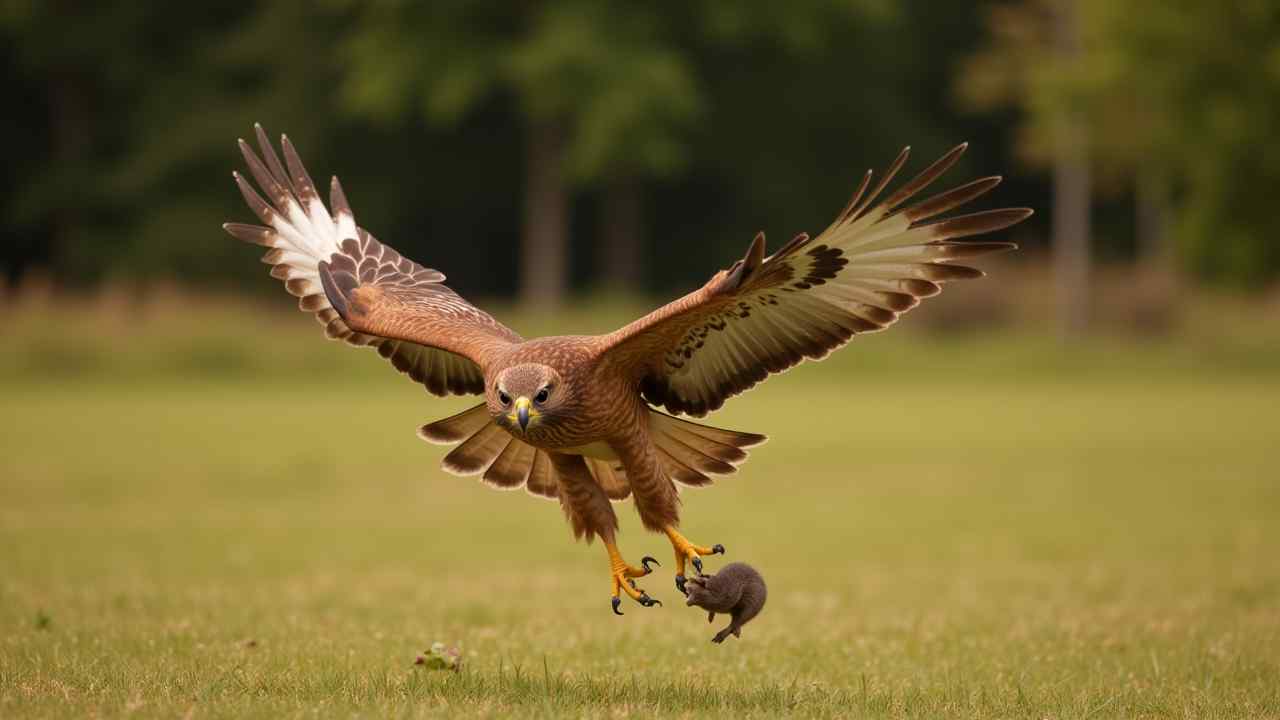
The hawk has two "weapons." The Eyes. And the Talons. 1. The Eyes (The "Binoculars") 👁️ A hawk's eyesight is legendary. It is not "good." It is a superpower. It has 8x the "visual acuity" of a human. It can see tiny movements... ...from half a mile away. It is sitting on that pole. Scanning the grass. It is waiting. Waiting. 2. The "Pounce" (The Kill): It sees it. A "vole" (a mouse) moves in the grass. (100 yards away). ( The hawk launches. It is a silent, shallow glide. It is a "surprise" attack. At the last second, it drops its "weapons." The Talons. 3. The Talons (The "Weapons") ⚡ The talons are the real weapon. Not the beak. The talons are not "feet." They are "vise-grips" with knives. They hit the vole with crushing force. The talons "puncture" the animal. The "grip" itself is the kill. It is a "hydraulic press." 4. The Beak (The "Fork") The hawk now has its (dead) vole. It flies back to a safe perch. Now, it uses its beak. The beak is not for "killing." It is for eating. It is a "fork and knife." It is a "meat-ripper." It has a "tomial tooth." (A sharp "notch"). (This helps it "snip" the spine. (If needed). ( But its main job is to tear... ...bite-sized chunks of meat.
The Primary Menu (The 90% - Mammals) 🐀
This is the core of the diet. This is the "90%" list. The hawk is a "rodent-control" machine. The diet is 90% small mammals. This is their "job." This is their "preference."
1. Voles (The "Bread and Butter")
This is the #1, 10/10, favorite food. (In most of its range). ( Voles are "field mice." They are small, "meadow-mice." They are everywhere. They are the "base" of the food chain.
2. Mice & Rats
This is the "urban" diet. A hawk in a city... ...is a "rat-control" machine. A hawk in a barn... ...is a "mouse-control" machine.
3. Gophers & Prairie Dogs
This is the "plains" diet. In the West (USA)... ...the hawk is a "gopher-eater." This is why they are a farmer's friend. (We will cover this later). (
4. Rabbits (The "Big" Meal) 🐇
This is a major food source. Especially in winter. (When voles are hidden by snow). ( A Red-Tail is 100% big enough... ...and 100% strong enough... ...to kill and carry a cottontail rabbit. This is a big meal. It can feed the hawk for 1-2 days.
5. Squirrels (The "Tough" Meal) 🐿️
This is a "high-risk" meal. (For the hawk). (A squirrel is not a "vole." A squirrel has claws. And teeth. And it fights back. A hawk will hunt a squirrel. But it is a "hard" meal. An "adult" hawk (an expert)... ...is a good squirrel hunter. A "young" hawk might fail.
The Secondary Menu (The "Opportunist")
This is the "other 10%." Remember: The hawk is an opportunist. It prefers mammals. But it will not starve. If a mammal is not available... ...it will eat "Tier 2" food.
1. Birds (The "Air" Meal)
This is the #2 food group. It is not their "specialty." (That is a Falcon's job). ( But they are very good at it. They will not catch a bird in mid-air. They are too slow (not "agile"). They will catch a bird... ...on the ground. Or on a branch. The "Victims":
- Starlings (A 10/10 choice)
- Blackbirds (Red-winged, etc)
- Pigeons (in the city)
- Meadowlarks
- Quail (A ground-bird. Easy target). (
2. Reptiles (The "Cold" Meal) 🐍
This is the "summer" food. In the hot parts of the US (Texas, Arizona)... ...reptiles are a major food source. The "Victims":
- Lizards: An easy, "ground-based" snack. A
- Snakes: Yes, they hunt snakes. They are 10/10 snake-killers. A
3. Other (The "Weird" List)
This is the "desperation" list. It is the "I am hungry and I will eat anything" list.
- Carrion (Roadkill): Yes. A hawk is not a "vulture." But it is "proud." I
- But if it is a hard winter... ...and it finds a "fresh" dead deer... ...it will (100%) eat the free meal. I
- Insects: (A "summer" snack). (A "swarm" of grasshoppers... ...is a "protein" snack. They will eat them. T
- Amphibians/Fish: (Frogs, toads, small fish in a shallow pond). (
The "Chickenhawk" MYTH (The Trap) 🚫
This is the most important section of this guide. You must understand this. This is the "myth" that kills hawks. The Myth: A farmer sees a Red-Tailed Hawk. He thinks: "That is a Chickenhawk!" He thinks the hawk is there... ...to "steal" his chickens. So, he (illegally) shoots the hawk. (This is a federal crime!). ( He thinks he "saved" his chickens. He is 100% WRONG. He has just killed... ...his best employee.
The Truth: They are a "Farmer's Friend" ✅
This is the 100% truth. Red-Tailed Hawks are a farmer's best friend. T Why? Look at the "Primary Menu" (the 90% list). What is on it? Rats. Mice. Voles. Gophers. Rabbits. What do these animals do? They EAT THE FARMER'S CROPS. They are "pests." They are the real enemy. The hawk is not a "chickenhawk." It is a "Rodent-Hawk." It is a "Vole-Hawk." It is "nature's pest control." A single hawk family... ...can remove 1,000+ rodents... ...from a farm in one season. For free. A smart farmer loves his hawks. He protects them.
The "Exception" (The "But...")
So, will a hawk ever eat a chicken? Yes. Of course. (Remember: "Opportunist"). ( A "chicken" is a "bird." (See the "Secondary Menu"). ( If a farmer is careless... ...and he lets his baby chicks... ...(a "bantam" (small) chicken)... ...run unprotected in an open field... ...a hawk might see this as an "easy" meal. (It is just a "stupid, slow bird"). ( A Red-Tail is not strong enough... ...to carry off a 6lb adult chicken. (A "Great Horned Owl" can. But not a Red-Tail). ( So, yes, it can happen. But it is extremely rare. It is not their "preference." They prefer the "wild" rodents. The "Chickenhawk" name is a 99% lie.
How Do They Eat? (Digestion & Pellets)
This is the final, "science" part. How do they digest this food? They do not have "teeth." They cannot "chew." 1. The "Tear": The talons kill the vole. The beak rips the vole. It tears off bite-sized chunks. 2. The "Swallow": The hawk swallows these chunks whole. This includes:
- Meat (The "food")
- Bones
- Fur
- Teeth
Conclusion: The "Vole-Eater"
This is the final summary. The Red-Tailed Hawk is a carnivore. It is an "opportunist." But it is NOT a "Chickenhawk." 🚫 It is a "Rodent-Hawk." 🐀 Its diet is 80-90% small mammals. (Voles, mice, rats, gophers, rabbits). ( The "other 10%" is:
- Birds (Starlings, Pigeons)
- Reptiles (Snakes, Lizards)
- Carrion (if desperate)