R-Value Sleeping Pad Guide 🏕️
What is an R-Value? (The #1 Spec)
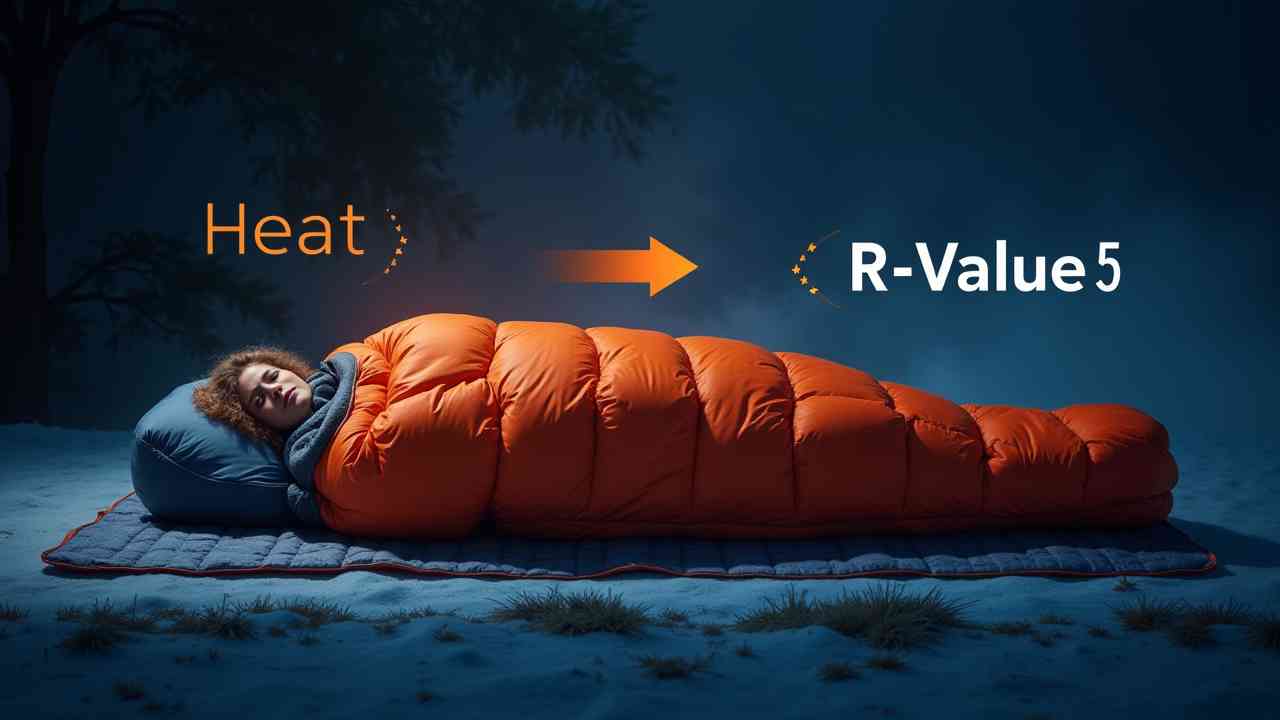
The R-Value is a number. It is the most important number on any sleeping pad. R-Value is not about comfort. It is not about "softness." R-Value is a scientific measurement. It measures Thermal Resistance. In simple terms: It is a measure of warmth. 🔥 A high R-Value means high resistance. It is very warm. A low R-Value means low resistance. It is not warm.
Why R-Value is More Important Than Your Sleeping Bag
This is the #1 secret to staying warm. People misunderstand this. They spend 500 on a 0-degree sleeping bag. Then they put it on a 10 air mattress. They freeze all night. 🥶 Why? The ground is a "heat sink." It will suck the warmth from your body. This is called conduction. Your sleeping bag's insulation... (the down or synthetic fluff)... ...only works when it is fluffy. It traps air (this is called "loft"). The part of the bag underneath you is crushed. Your body weight flattens it. It has no loft. It has zero insulation. 🚫 Your sleeping bag protects you from the cold air. Your sleeping pad protects you from the cold ground. You need both. Your pad is 50% of your sleep system. If your pad's R-Value is too low, you will be cold. Guaranteed.
The ASTM Standard: The R-Value You Can TRUST 🔬
For decades, R-Values were a lie. It was the "wild west." Brands just made up a number. There was no standard. A "R-4" from one brand was an "R-2" from another. It was confusing and dangerous. This all changed in 2020. The industry finally agreed on a standard. It is called the ASTM F3340-18 standard. This is a scientific, third-party lab test. All the major brands now use this test. (REI, Therm-a-Rest, NEMO, Sea to Summit, Big Agnes). ( This is a huge win for you. It means you can trust the number. An R-Value of 3.5 from Therm-a-Rest... ...is the exact same warmth as an R-Value of 3.5 from NEMO. You can finally compare them accurately.
The R-Value Chart: What Number Do You Need? 🌡️
This is the simple part. Just match the number to the weather. Always be safe. Choose a pad for the coldest temperature you expect to face. R-Value 1.0 to 2.0
- Season: Summer Only ☀️
- Good for: Warm weather. (e.g., 50°F / 10°C and up).
- This is for: Peak summer camping. Desert camping. Hostel travel. T
- Example: A basic, non-insulated air pad.
- Season: 3-Season (The Sweet Spot) 🍂
- Good for: Spring, Summer, and Fall. (e.g., 32°F / 0°C and up).
- This is for: This is the "all-around" pad. It is the most versatile. Most backpackers and campers should get a pad in this range. A classic foam pad (like a Z-Lite) is R-2.0 to R-2.6. A good self-inflating pad is R-3 to R-4.
- Season: All-Season / Early Winter 🏔️
- Good for: Cold weather. (e.g., 10°F / -12°C and up).
- This is for: Cold fall nights. High-altitude camping. Sleeping on cold, rocky ground. These are "warm" pads. They often have insulation inside.
- Season: Winter / Expedition ❄️
- Good for: Extreme cold. (e.g., 0°F / -18°C and below).
- This is for: Sleeping on snow. This is a non-negotiable. If you are a winter camper, you need an R-Value of 6 or higher. These are high-tech, heavily-insulated pads.
The Pro-Hack: Stacking R-Values 🥞
This is a critical, life-saving winter camping skill. What if you have two pads? The R-Values are additive. They stack! This is the "Two-Pad System." It is the gold standard for winter safety. 🥇 Here is the system: Pad 1 (Bottom): A Closed-Cell Foam (CCF) Pad. (e.g., Therm-a-Rest Z-Lite). (
- This pad is indestructible. It cannot pop. It is your "failsafe."
- It has an R-Value of R-2.0.
- This pad is comfortable. It is very warm.
- It has an R-Value of R-6.9.
How Do Pads Get Their R-Value?
How is an R-Value created? By trapping air.
Closed-Cell Foam (CCF) Pads
These are the folding, accordion-style pads. (e.g., Z-Lite). ( The R-Value comes from the foam itself. The foam is full of tiny, trapped, "closed" air bubbles. They are cheap. They are indestructible. They are also bulky. And they have a low R-Value (R-2.0 to R-2.6). The "Sol" (silver) versions have a reflective layer. This shiny layer reflects your body heat. 🔥 It adds about 0.5 to the R-Value. Always sleep with the shiny side up.
Self-Inflating Pads
These are the classic Therm-a-Rest pads. They are a hybrid. They have open-cell foam inside. When you open the valve, the foam expands. It sucks air in. The R-Value comes from this internal foam. They have a great R-Value for their price. (R-3 to R-5). ( They are a great "middle ground" of comfort, cost, and warmth.
Inflatable Air Pads (Air Sprung)
These are the most popular, modern, ultralight pads. (e.g., NEMO Tensor, Sea to Summit Ether). ( They are just an "air mattress." They have no foam. So how are they warm? They are high-tech. They have insulation inside the pad. They use two main tricks. You can often see them if you hold the pad up to the light. 1. Baffles: They have complex internal walls. (Baffles). (This stops the air from moving (convection). If the air cannot circulate, it cannot get cold. 2. Reflective Film: This is the big one. They have one or more layers of reflective film inside. (It is like a Mylar "space blanket"). ( This film is a miracle. It reflects your body heat (infrared radiation) back at you. 🔥 This is how a tiny, 1-pound pad... ...can have a massive R-Value of 7.0. It is a very "warm" and "efficient" technology. The only drawback? This film is often noisy. The pad can sound "crinkly." (Like you are sleeping on a bag of potato chips). ( This "crinkle" is the sound of you being warm. Many hikers are happy to accept it.
Conclusion: R-Value is Not Comfort, It's Survival
R-Value is the most important number on your pad. It is a standard you can trust (ASTM F3340-18). I