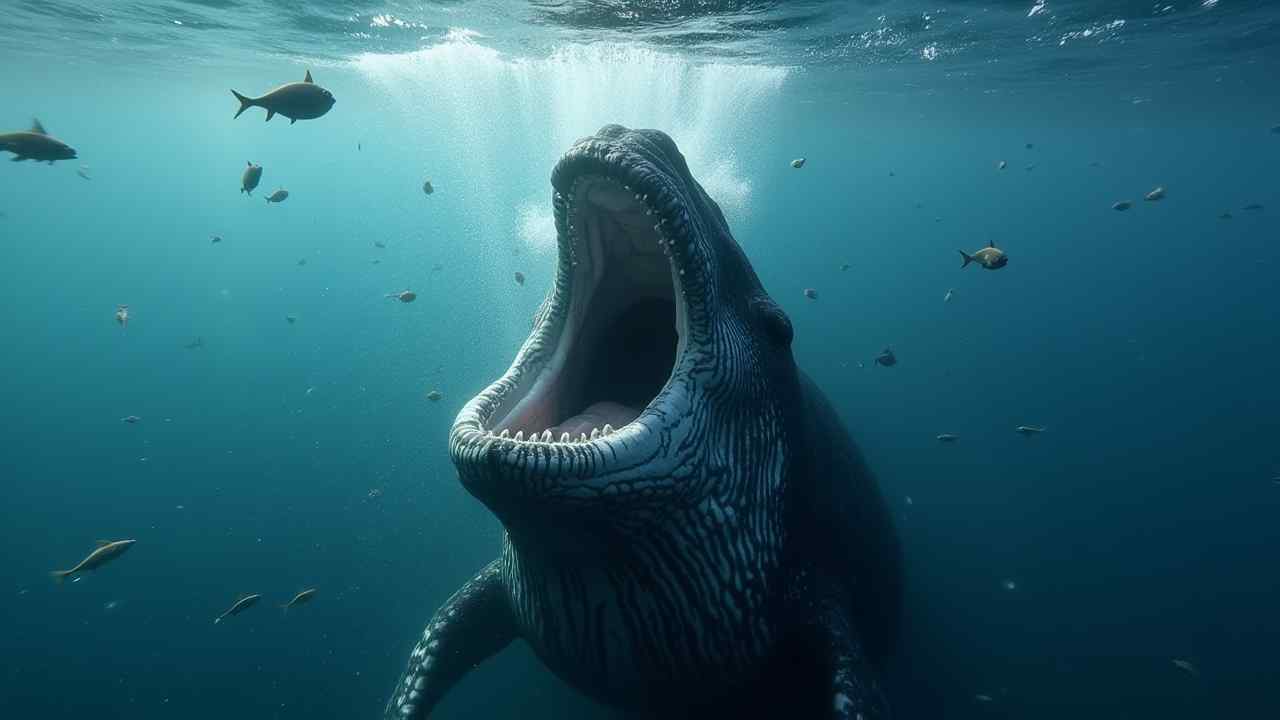
Humpback Whale Diet Guide 🐋
What is a Humpback Whale?
The Humpback Whale is a giant animal. It is a species of baleen whale. It is a marine mammal. It is famous. We all know what it looks like. We know it from nature documentaries. It is the star of the ocean. It is famous for its magical songs. 🎶 And for its acrobatic breaches. (Jumping out of the water). ( A Humpback is huge. An adult can be 50-60 feet long. And weigh 40 tons. (That is 80,000 pounds!). ( How does an animal get this big? What does it eat to fuel that giant body? This guide will explain the humpback whale diet. It is a fascinating story. It is a story of "feast and famine." And it is a story of pure genius.
What Do Humpback Whales Eat? (The Menu)
A humpback whale is a carnivore. It eats meat. But it is a "gentle giant." It does not have big teeth. It does not hunt seals or sharks. (Like an Orca does). ( A humpback whale is a filter feeder. This is the most important concept. It filters its food from the water. So, it must eat tiny prey. But it eats a lot of it. The diet is very simple. It has two main food groups.
1. Krill 🦐
This is the #1 food source. Especially for whales in the Southern Ocean. (Antarctica). ( What is krill? It is a tiny, tiny animal. It looks just like a tiny shrimp. Krill live in the ocean. They live in massive groups. These groups are called "swarms." A single swarm can have billions of krill. It can be a giant, pink cloud... ...that is miles wide. This is the perfect food for a whale. It is pure protein and fat. It is a "superfood." The whale just has to find this "cloud"... ...and swim through it with its mouth open.
2. Small Schooling Fish 🐟
This is the #2 food source. This is the main food in the Northern Hemisphere. (Like in Alaska or Norway). ( Humpbacks do not hunt one fish. That is too much work. They hunt an entire school of fish. They look for a "bait ball." This is a dense, swirling ball of fish. Their favorite fish are:
- Herring: A very common, oily fish.
- Capelin: A small, cold-water fish.
- Sand Lance: (Also called "sandeels").
- Anchovies: (In certain areas).
- Sardines: (Also a popular choice).
How Humpbacks Eat: The "Filter Feeder" System
This is the most important part to understand. Humpback whales have NO TEETH. Zero. They are not "toothed whales." (Like a sperm whale or a dolphin). ( They are a Baleen Whale.
What is Baleen? 🦷🚫
Baleen is not teeth. It is a "filter." It is a giant sieve. It is a series of keratin plates. Keratin is the exact same material... ...as your fingernails and hair. 💅 These plates are long and flexible. They hang down from the whale's top jaw. Like a curtain. Or a giant, bristly comb. This baleen filter is the only tool the whale needs. It is how they separate the food from the water.
Method 1: Lunge Feeding (The Gulp) 😮
This is the simple, "brute force" method. It is used for a big, dense swarm of krill. Step 1: The Gulp. The whale opens its mouth. Its mouth is enormous. A bus could fit inside. The whale's throat has "ventral pleats." These are grooves that expand. Like an accordion. 🪗 This allows the whale to take one, giant gulp. The gulp is thousands of gallons of water. And thousands of pounds of krill. Step 2: The Push. The whale's mouth is now full. It is a giant, watery balloon. It closes its mouth. Now, it uses its huge, powerful tongue. It pushes all the water out. Step 3: The Filter. The water is pushed through the baleen. The water escapes. But the krill cannot. The krill (or fish) are trapped. They are caught in the bristly "comb." Step 4: The Swallow. The whale is left with a "slurry" of pure food. It licks the baleen clean. And it swallows its meal. A perfect, filtered gulp.
Method 2: Bubble-Net Feeding (The Genius Method) 💨
This is the famous, "smart" method. It is one of the most amazing acts in nature. It is a sign of high intelligence. And of cooperation. A "team" of whales works together. The Problem: Fish are smart. And they are fast. A school of herring can see a whale. They can "lunge" away. They can escape the gulp. So, the whales must trap the fish first. But they have no hands. T So, they build a net. A net made of BUBBLES.
How Bubble-Net Feeding Works:
Step 1: The "Dive." A team of whales (3 to 15 of them) will find a school of fish. They dive deep. They go under the fish. Step 2: The "Net." One or two "lead" whales will dive. They will start to swim in a slow, upward circle. As they swim, they blow bubbles from their blowhole. This creates a "curtain" of bubbles. A "bubble-net." This net rises to the surface. Step 3: The "Trap." The fish are scared of this bubble wall. They see it as a solid barrier. They will not swim through it. The whales "corral" the fish. The circle gets smaller. And smaller. The fish are pushed into a tight, panicked "bait ball." In the center of the net. They are trapped. They have nowhere to go. Step 4: The "Feeding Call." 📣 The lead whale then makes a sound. A "feeding call." This is the signal. "Now!" "Attack!" " Step 5: The "Feast." All the whales in the team... ...then swim up through the center of the bubble-net. Their mouths are wide open. They erupt at the surface. All at once. They each take a massive gulp. They catch the entire, trapped school of fish. This is an amazing, complex, social behavior. It is learned. It is not just "instinct." Mothers must teach this technique... ...to their young calves. This is a true sign of animal "culture."
The "Feast & Famine" Diet (The Timing)
This is the final, amazing part of the diet. It is seasonal. A humpback whale lives a life of "feast or famine." The two seasons control its entire life.
The Summer: The FEAST (In Cold Water) ☀️
The summer is the "feeding season." This is the "feast." Where do humpbacks go for the summer? To the cold polar waters. They go to Alaska. Antarctica. Norway. Why? That is where the food is. The cold water is rich in nutrients. It is full of krill and herring. The whale's job in the summer is simple: EAT. They eat all day. Every day. For months. How much do they eat? A single, adult humpback whale... ...can eat 1 to 1.5 TONS of food... ...every single day. (That is 2,000 to 3,000 pounds!). ( This is a massive feast. They are not eating for "daily energy." They are eating for "storage." They are building their blubber. Blubber is a thick, rich layer of fat. It is their "battery." It is their "savings account." This is the "feast." They get as fat as possible.
The Winter: The FAMINE (In Warm Water) ❄️
The winter is the "breeding season." This is the "famine." Now, the whales migrate. They travel thousands of miles. They go to the warm, tropical waters. They go to Hawaii. Mexico. The Caribbean. Why? To have their babies. The "calves." A baby whale (a calf) is born... ...with very little blubber. It cannot survive the freezing Alaskan water. It would die of hypothermia. So, the mothers must give birth in a warm "nursery." (Like in Hawaii). ( But here is the problem: The warm, clear, tropical water... ...is a food desert. There is no krill. There are no herring schools. There is nothing to eat. So, what do the humpback whales eat... ...for their entire winter migration? NOTHING. 🚫 They fast. They eat zero food for 4 to 6 MONTHS. How do they survive? They live off their blubber. They are using their "battery." They are living off their "savings account." A mother whale is the most impressive. She fasts for 4-6 months... ...while giving birth... ...and producing dozens of gallons... ...of super-high-fat (50% fat!) milk... ...for her growing calf. Every single day. This is an amazing feat of biology. She may lose one-third of her entire body weight... ...during this "famine" season. This is the cycle. The summer "feast" (krill, fish)... ...is what powers the winter "fast" (breeding).
Conclusion: A Smart and Simple Diet
The humpback whale diet is a story of extremes. It is simple, but it is smart. The Food: They are carnivores. They are filter feeders. They use baleen (not teeth). They eat krill 🦐 and small schooling fish 🐟. The Method: They are smart. They use "lunge feeding" for krill. And they use bubble-net feeding to trap fast fish. T The Timing: They are "feast-or-famine" eaters. They FEAST in the summer (cold water). They eat tons of food. They FAST in the winter (warm water). They eat nothing for months. It is an amazing, extreme, and brilliant survival plan. One of the best in the animal kingdom. 🌟