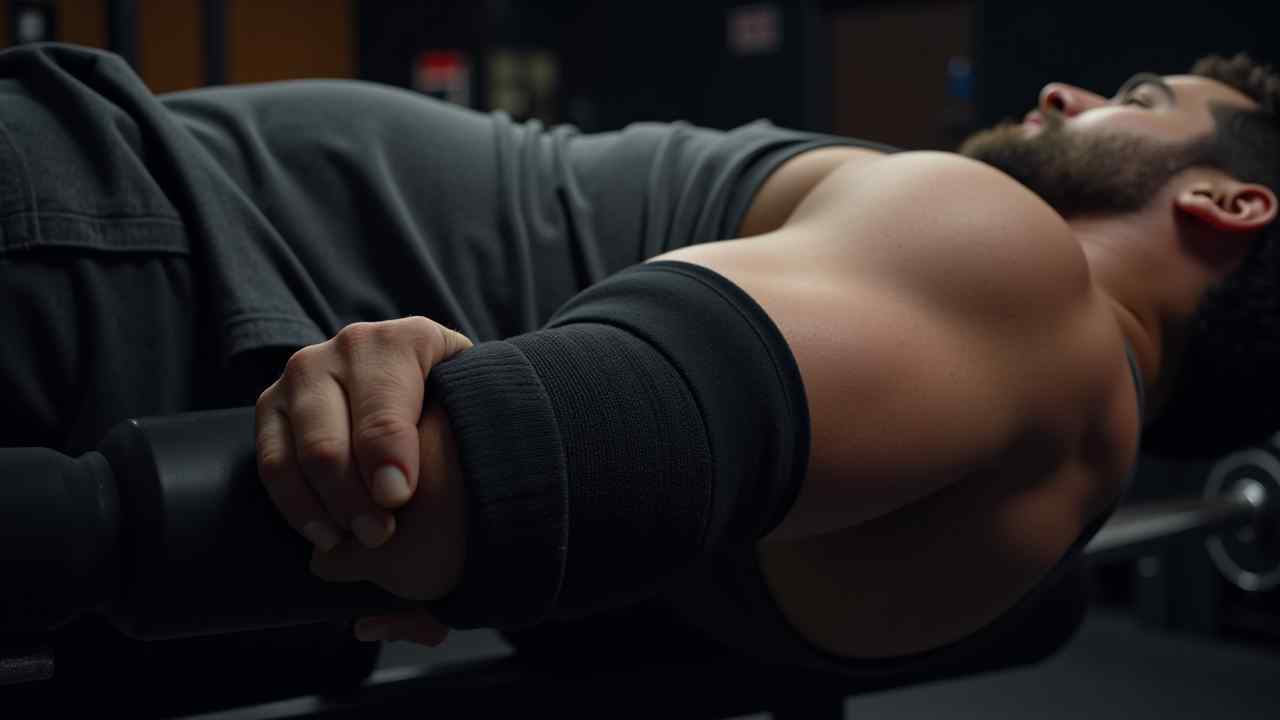
Elbow Sleeve Guide 🏋️ (Pros/Cons)
What is an Elbow Sleeve for Weight Training?
An elbow sleeve is a popular gym tool. It is a piece of "supportive gear." It is not a "fashion" item. It is a functional tool. It is a tube of "stretchy" material. You pull it up over your arm. It covers your elbow joint. And your bicep and forearm. This material is usually Neoprene. (The same material as a wetsuit). ( This material is the "magic." It is thick. (3mm, 5mm, or 7mm). (And it is "compressive." It "squeezes" you. This "squeeze" and "warmth"... ...is the entire point of the sleeve. It is designed to help your joints. Especially during heavy "pressing" movements. This includes:
- The Bench Press 🏋️
- The Overhead Press (OHP)
- Dips
- Strongman lifts (log press, etc.)
The #1 Myth: A "Brace" vs. a "Sleeve" 🚫
This is the most important part of this guide. People misuse this tool. Because they misunderstand its job. A Brace (like a medical brace) is different. A brace has hinges. It has straps. It is designed to PREVENT movement. It is a "stop sign" for your joint. It is for medical injury. A Sleeve (a compression sleeve) is the opposite. A sleeve has no hinges. It has no straps. It is designed to SUPPORT movement. It is a "compression" tool. It is for performance and comfort. An elbow sleeve... ...will NOT stop you from tearing your bicep. It will NOT stop you from injuring your joint. It is not a medical device. It is not a "fix" for bad form. It is a comfort tool. And a "feedback" tool. That is all. Do not confuse them.
The REAL Benefits (The "Pros") ✅
So, what does it actually do? It has 3 real, proven benefits.
1. Warmth & Blood Flow (The #1 Benefit) 🔥
This is the main, undisputed benefit. The sleeve provides warmth. The neoprene material is an "insulator." It is a "heat-trapper." (Just like a wetsuit). ( It traps your own body heat. This heat is the magic. Heat increases blood flow. (This is "vasodilation"). ( This increased blood... ...delivers oxygen to the joint. It "lubricates" the joint. It makes it feel "warmer." And "less creaky." This is a huge benefit... ...for people with "achy" joints. Or arthritis. Or for people who train in a cold garage gym. (A 10/10 tool for this!). ( This is the "comfort" pro. It just makes lifting feel better.
2. Compression (The "Hug") 🤗
This is the second benefit. The sleeve is tight. It is "compressive." This "squeeze" (or "hug")... ...provides a feeling of stability. And "support." It makes the joint feel "locked-in." It feels safer. This is a psychological benefit. It is a confidence boost. When you are under a 300lb bench press... ...a little extra "confidence"... ...is a very powerful thing. It can help you push harder.
3. Proprioception (The "Feedback" Tool) 🧠
This is the real "secret weapon" of a sleeve. Proprioception. This is a big, fancy word. It means "body awareness." It is your brain's "sense" of where your body is. It is the "mind-muscle connection." The "tight squeeze" of the sleeve... ...is constantly "touching" your skin. It is "reminding" your brain... ...that your elbow exists. "Hey! Pay attention to this joint!" This "feedback" is amazing. It makes you focus on your elbow. It improves your lifting form. You will "tuck" your elbows better. You will "feel" the movement more. You will have a better, cleaner, safer lift. This is the #1 "performance" benefit. It is a "coaching" tool.
The DANGERS & "Cons" (The Risks) 🚨
This tool is not perfect. It has major, serious risks. You must know them.
1. The "Pain Mask" (The #1 DANGER) masking
This is the most dangerous risk. It is a classic "rookie" mistake. You have a sharp pain in your elbow. (e.g., "Tennis Elbow" or "Golfer's Elbow"). ( This is TENDONITIS. This is an injury. Your body is screaming at you. ("STOP! We are injured!"). ( So, what do you do? You "Google" it. And you buy an elbow sleeve. You put the sleeve on. The warmth and compression... ...make the pain go away. (Or feel "dull"). ( You think: "I am cured!" So, you go back to lifting heavy. This is a disaster. You are not "cured." You have just "muted" the fire alarm. (While the fire is still burning). ( You are masking the pain. This allows you to train through the injury. And you are making the injury worse. Much worse. You are turning a "2-week" injury... ...into a "6-month" chronic injury. It is a terrible idea. The Rule: Do NOT use a sleeve... ...to "mask" a sharp, new, or existing pain. If you have real pain, see a doctor. Or a physical therapist. Heal the injury. Do not "mute" it.
2. The "Crutch" Problem (Dependency)
This is the second risk. Dependency. You get used to the "hug." You start to rely on it. Your brain "forgets" how to lift... ...without the sleeve. You feel "naked" and "weak" without it. This is a "mental crutch." It can also be a "physical crutch." Your "stabilizer" muscles... (The small, deep muscles around the joint)... ...can get "lazy." They think: "The sleeve is doing my job! I can turn off." This makes your un-sleeved joint... ...weaker and less stable over time. The Fix: Use the sleeves only for your heaviest sets. (See "How to Use" below). (
3. The "Lift" is a Myth (Knees vs. Elbows)
This is a powerlifting myth. In a squat, you use Knee Sleeves. A 7mm (thick) knee sleeve... ...is very stiff. It "stores" energy at the bottom. It helps you stand up. It physically adds pounds to your lift. (This is called "rebound"). ( People assume an elbow sleeve does the same. It does not. An elbow sleeve is NOT stiff enough. It will NOT add 20 lbs to your bench press. It is not a "cheater" tool (like a bench shirt). Its benefit is 99% warmth, comfort, and psychology. Not "rebound." Do not expect a "magic" lift.
How to Choose Your Sleeve (The 3 Rules) 🛒
You are ready to buy. Great. Here are the 3 choices.
1. The Material (Neoprene vs. Cloth)
Cloth / Knit Sleeves: These are the "cheap" ones. (Often black or tan). (They are breathable. They are comfortable. But: They are useless for weightlifting. They provide no warmth. And no real compression. They are for "arthritis comfort." Skip these. Neoprene Sleeves: ✅ This is the one you want. It is the "wetsuit" material. It provides the warmth. And the compression. This is the "real" lifting sleeve.
2. The Thickness (3mm vs. 5mm vs. 7mm)
This is the most important choice. The "thickness" (in millimeters) is the "power." 3mm (Light): This is a "light" sleeve. It is for endurance sports. (Like CrossFit WODs). (It is very flexible. It gives warmth, but not much "support." 5mm (The "All-Purpose"): ✅ This is the gold standard. It is the "best of both worlds." It is thick enough for great warmth. And great compression. But it is flexible enough... ...for all-around training. (CrossFit, general lifting). ( This is the one I recommend for 90% of people. 7mm (The "Power" Sleeve): This is the "heavy-duty" sleeve. It is very thick. And very stiff. This is a "Powerlifting" tool. It is for maximum support... ...on a maximum-effort bench press. It is too stiff for most people. It is not comfortable for a general workout. This is a "specialist" tool.
3. The Fit (It MUST Be SNUG!) 🔑
This is the final, critical step. The fit. A "loose" elbow sleeve is 100% USELESS. It is a "cloth tube." It is not "compressive." It is not "supportive." It is a waste of money. A "snug" sleeve is the goal. It must be tight. You should have to work to pull it on. It should feel like a "firm hug." A "too-tight" sleeve is dangerous. If your hand turns blue... ...or it is "pulsing"... ...it is too tight! You are cutting off blood. Take it off. The Rule: Get a soft measuring tape. Flex your bicep. Measure your elbow joint. Then, check the sizing chart for the brand. (e.g., SBD, Rehband, Slingshot). ( When in doubt, size down. (Not up). (They will stretch a little. Snug is good.
How to Use Them (The Smart Way)
This is how you avoid the "crutch" problem. Do not become "dependent" on them. Use them as a tool.
Rule 1: Warm Up Without Them.
This is the "pro" tip. Do not put them on in the car. Do your "warm-up" sets... ...with "naked" elbows. (e.g., The empty bar, 95 lbs, 135 lbs). ( This forces your "stabilizer" muscles... ...to wake up and do their job. It builds real, "un-supported" strength.
Rule 2: Put Them On for the "Work Sets."
Now, you are at your "work weight." (e.g., your heavy 3x5 sets). ( NOW you put the sleeves on. This is your "armor." This is your "confidence." This is your "warmth" for the heavy load.
Rule 3: Take Them Off Between Sets.
Do not "wear" them for 2 hours. Your arm will get sweaty. And itchy. A 7mm sleeve is very tight. It will cut off blood. It is "competition" gear. The Rule: Put them on. Do your set. Take them off. Rest. Repeat. A 5mm sleeve is more forgiving. You can leave it on. But it is good to "air out" the joint.
Conclusion: A Tool, Not a Cure
An elbow sleeve is a fantastic tool. It is a "comfort" and "confidence" tool. It is not a "strength" tool. (Like a knee sleeve). ( Its #1 benefit is WARMTH. This increases blood flow. And this reduces the sensation of "achiness." Its #2 benefit is PROPRIOCEPTION. The "squeeze" improves your form. The Golden Rules: 1. NEVER use a sleeve to mask sharp pain. 🚫 This is the #1 danger. You are hurting yourself. See a doctor! 2. Buy the right thickness. (5mm is the best "all-around" choice). ( 3. Buy the right fit. (It MUST be SNUG). ( 4. Do not get "addicted" to them. Warm up with "naked" elbows. This is the plan. They are a smart tool for a smart lifter. They are not a "crutch" for an injured one. Be smart. Be safe. And get strong. 🌟