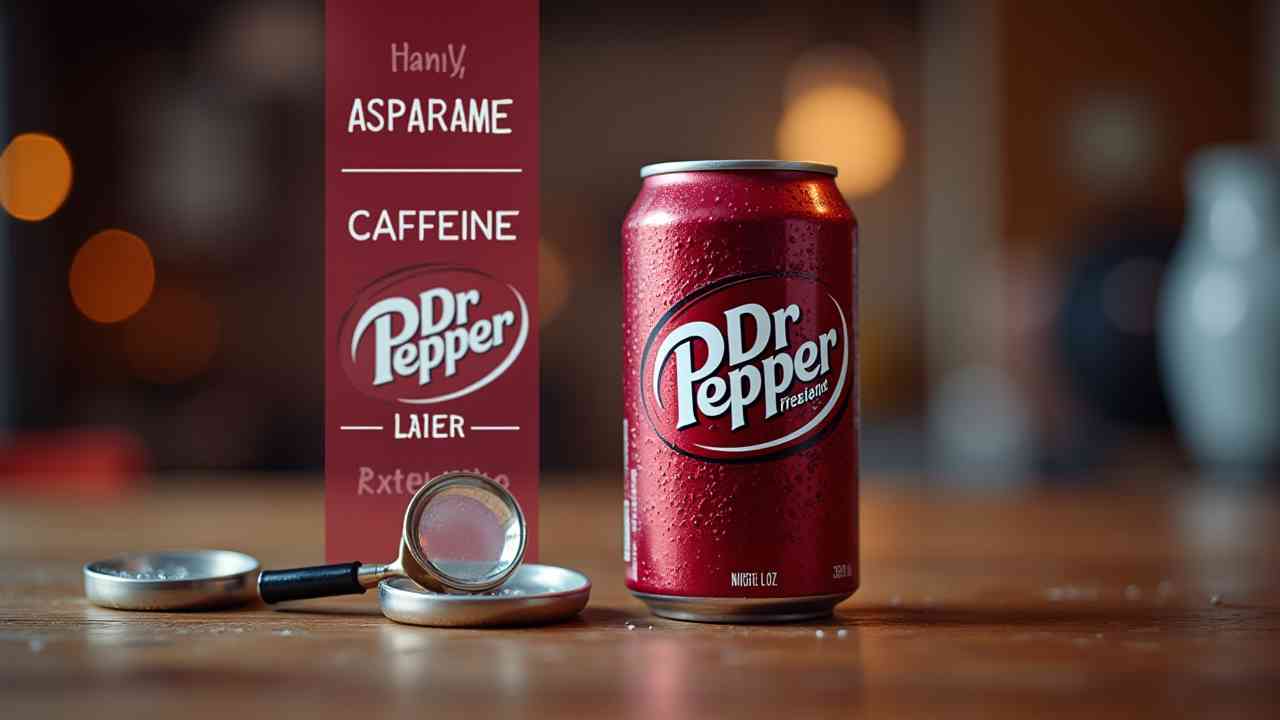
Diet Dr Pepper Ingredients 🥤🧪
What is Diet Dr Pepper?
Diet Dr Pepper is a popular soft drink. 🥤 It is a non-caloric version of the original. It has a unique, hard-to-define flavor. It is famous for its "23 flavors" ad campaign. 🍒 The main appeal of the "diet" version is simple. It contains zero sugar and zero calories. 🚫 This makes it a very popular choice. It is for people on a diet. (e.g., Keto). It is also a common choice for diabetics. 🩺 They must manage their blood sugar intake. But how does it get its taste? How is it zero-calorie? The answer is in its ingredients. 🧪 This guide will break down the label. We will go line by line. We will explain what each ingredient is. We will also explain what it does. This is your complete guide to the ingredients in Diet Dr Pepper.
The "Diet" Promise: Zero Sugar, Zero Calories
Before we list the ingredients, let's understand the "diet" promise. A regular 12-ounce can of Dr Pepper is a sugar bomb. 💣 It has about 150 calories. It has 40 grams of sugar. 🤢 This sugar is High Fructose Corn Syrup. (HFCS). This sugar load will spike your blood sugar. It will lead to a crash. Diet Dr Pepper is a direct replacement. It has 0 calories and 0 grams of sugar. This is possible because it does not use HFCS. It uses non-nutritive sweeteners. 💡 These are sweeteners with zero calories. They are not digested for energy. This is the key to the entire "diet" formula.
The Full Ingredient List: A Breakdown
Let's look at a typical 12-ounce can. 🥫 The ingredients are listed by weight. The first item is the most plentiful. A typical can of Diet Dr Pepper contains:
- 1. Carbonated Water
- 2. Caramel Color
- 3. Aspartame
- 4. Acesulfame Potassium
- 5. Natural and Artificial Flavors
- 6. Phosphoric Acid
- 7. Sodium Benzoate (Preservative)
- 8. Caffeine
Ingredient 1: Carbonated Water
This is the main ingredient. It is the base of all sodas. It is simply purified water. 💧 It has been infused with carbon dioxide (CO2) gas. This infusion is done under high pressure. It is what creates the bubbles. It is the "fizz." 💨 This ingredient is perfectly safe. It is just water and gas. It has no calories, no sugar, and no sodium. The carbonation itself also adds a slight "bite." This mild acidity is part of the soda-drinking experience. It is the canvas for all the other flavors.
Ingredient 2 & 3: The Sweetener System 🧪
This is the most important and controversial part. 🤫 Diet Dr Pepper gets its sweetness from a blend. It does not use just one sweetener. It uses two. Why a blend? A blend tastes better. ✨ It creates a more "full" and "rounded" sweet taste. It mimics real sugar. It also helps to mask any "diet" aftertaste. 😝 The two sweeteners are Aspartame and Ace-K.
Sweetener A: Aspartame
Aspartame is the primary sweetener. It is the most famous one. It was approved by the FDA in 1981. It is one of the most-studied food additives in history. Aspartame is about 200 times sweeter than table sugar. 🍬 This means you only need a tiny, tiny amount. The amount used is so small that its calorie count is zero. (Less than 1 calorie). Aspartame is made from two amino acids. These are aspartic acid and phenylalanine. These are the building blocks of protein. 🧬 When you drink it, your body breaks it down. It is digested just like the protein in an egg. 🥚
Is Aspartame Safe?
This is the big debate. The science is complex. In 2023, the World Health Organization (WHO) made headlines. One of its groups (the IARC) classified Aspartame. It was classified as "possibly carcinogenic to humans" (Group 2B). 📰 This sounds very scary. 😱 But this "Group 2B" is a hazard identification. Not a risk assessment. Group 2B includes many other things. This includes aloe vera extract. It includes pickled vegetables. 🥒 It means "there is limited evidence it could cause cancer." The other WHO group (JECFA) did a full risk review. They are the group that sets safety limits. They did not change the safety limit. They reaffirmed it. ✅ The "Acceptable Daily Intake" (ADI) is 40-50 mg per kilogram of body weight. Let's do the math for a 150-pound (68kg) person. ⚖️ Their daily "safe" limit is 3,400 mg of Aspartame. (Using the FDA's 50mg/kg rule). A 12-ounce can of Diet Dr Pepper has less than 200mg. (Around 180mg). You would have to drink about 19 cans of Diet Dr Pepper... ...every single day... ...for your entire life... ...to hit this official "safe" limit. This is why all major food agencies... (the FDA, EFSA, and WHO)... ...state that Aspartame is safe. It is safe at its current consumption levels.
The PKU Warning (Phenylketonurics) ⚠️
You will see this warning on every can. "PHENYLKETONURICS: CONTAINS PHENYLALANINE." This warning is because of Aspartame. As we said, Aspartame is made of two amino acids. One is phenylalanine. This is not a danger for 99.9% of people. Phenylalanine is a normal amino acid. It is in chicken, milk, and nuts. But a very small number of people have a rare genetic disorder. It is called Phenylketonuria (PKU). Their bodies cannot process this one amino acid. It builds up and can cause brain damage. This label is a life-saving warning only for people with PKU. 🚫 If you do not have PKU, this warning does not apply to you.
Sweetener B: Acesulfame Potassium (Ace-K)
This is the second sweetener in the blend. 💡 It is also about 200 times sweeter than sugar. It is often used with Aspartame. They are partners. They have a "synergistic" effect. 🤝 This means when you combine them... the blend is sweeter than the two parts added together. This allows the company to use less of each sweetener. Ace-K also has a very fast, clean "hit" of sweetness. Aspartame's sweetness lasts a bit longer. The blend of the two mimics the taste of real sugar. This is the secret. 🔑 Ace-K is not digested by the body. It passes through you unchanged. This is why it is zero-calorie. It is also approved by the FDA and WHO. It has been studied for decades. It is considered safe.
Ingredient 4: Caramel Color
This ingredient is 100% for aesthetics. 🎨 It gives Dr Pepper its classic, dark brown/red color. If it was not added, your soda would be clear. (Like a Sprite or 7-Up). We "drink with our eyes." We expect a cola or pepper soda to be dark. Caramel color provides this visual cue. It makes the soda "look" right.
Is Caramel Color Safe?
This is another point of controversy. 🧐 This type of caramel color (Class IV) is made by heating sugar with ammonia. This process can create a byproduct. It is called 4-MEI (4-methylimidazole). In extremely high doses, 4-MEI has been linked to cancer in lab mice. 🐀 This led the state of California to add it to its Prop 65 warning list. This was a big deal. As a result, soda companies (like PepsiCo and Coca-Cola) changed their formulas. They dramatically reduced the 4-MEI levels. The FDA states the current levels are safe. You would have to drink thousands of cans a day to reach the danger level seen in animal studies. So, it is a controversial ingredient. But it is considered safe by all major food agencies in the tiny amounts used.
Ingredient 5: Natural and Artificial Flavors
This is the big secret. This is the "23 flavors." 🤫 The Dr Pepper flavor is famously complex. It is a secret recipe. It is not a simple "cola" flavor. It is a "pepper" style soda. People guess the flavors. They taste cherry, plum, prune, licorice, vanilla, and almond. 🍒 The ingredient list says "Natural and Artificial Flavors." This is a catch-all, proprietary term. "Proprietary" means it is a secret. The company does not have to list the 23 flavors. This protects their recipe. It stops competitors from copying it. All the flavors used are food-grade. They are approved by the FDA for consumption. This is what makes Dr Pepper taste like Dr Pepper. And not like Coke or Pepsi.
Ingredient 6: Phosphoric Acid
This is a critical ingredient. It serves two purposes. ✌️ 1. A Preservative: It is an acid. This acid creates an environment where mold and bacteria cannot grow. 🦠 It is a key part of making the soda shelf-stable. 2. A Flavoring Agent: This is the most important job. It provides flavor. 👅 It gives the soda its sharp, tangy, acidic "bite." Without this acid, the soda would taste flat. It would taste "flabby." The sweetness from the Aspartame would be overwhelming. The acid balances the sweetness. It is the sour to the sweet. This balance is critical.
Is Phosphoric Acid Safe?
Yes, in small doses. But it has two main health concerns. 1. Dental Health (The Big Risk) 🦷 This is a 100% real, proven risk. This is not a myth. Phosphoric acid is a strong acid. The pH of Diet Dr Pepper is very low (around 3.0 - 3.4). This strong acid directly dissolves tooth enamel. erosion It does not matter that there is no sugar. The acid is the problem. Sipping a diet soda all day is like bathing your teeth in a weak acid. It is very damaging. This leads to dental erosion. This makes your teeth thin, sensitive, and weak. 2. Bone Health (A Weaker Link) 🦴 This is an observational link. The evidence is mixed. Some large studies link high cola intake... ...with lower bone mineral density in women. (But not in men). This is a risk for osteoporosis. Why? The theory is the "phosphorus-calcium ratio." A diet that is very high in phosphorus (from colas)... ...and very low in calcium... ...can force your body to pull calcium from your bones. 📉 It does this to keep your blood pH stable. This is a long-term risk. It is associated with high consumption. (e.g., people who drink diet soda instead of water or milk).
Ingredient 7: Sodium Benzoate (Preservative)
This is another preservative. It is a common food-grade salt. Its job is to stop things from growing in the can. It is anti-fungal. It is anti-bacterial. 🛡️ It is very effective. It keeps the soda safe on the shelf for months. It is considered very safe by the FDA.
The Benzene Controversy (A Non-Issue Here)
There is a small, old controversy with this ingredient. When Sodium Benzoate is mixed with Vitamin C (ascorbic acid)... ...and then exposed to heat or light... ...it can form tiny amounts of benzene. 🔬 Benzene is a known carcinogen. This was a big scare for some orange sodas in the 90s. But... Diet Dr Pepper does not contain Vitamin C. 🚫 This chemical reaction is not a risk in this specific product. It is a non-issue here.
Ingredient 8: Caffeine
Yes, Diet Dr Pepper has caffeine. ⚡ It is a key part of the original 23-flavor formula. The caffeine adds a slight bitterness. This is a crucial flavor note. It balances the sweetness. It is also a stimulant. It is a "pick-me-up." It provides a mild energy lift. 🚀
How Much Caffeine is in Diet Dr Pepper?
This is a key question for many. A 12-ounce can of Diet Dr Pepper has 41 mg of caffeine. How does this compare? It is a moderate, standard amount.
- A 12oz Coke: 34mg
- A 12oz Diet Coke: 46mg
- A 12oz Regular Mtn Dew: 54mg
- A 12oz Pepsi Zero Sugar: 69mg
- A 8.4oz Red Bull: 80mg
- A 8oz Cup of Coffee: 95mg ☕
Diet Dr Pepper vs. Dr Pepper Zero Sugar
Are these the same? No. 🙅 They are two different drinks. They are both zero-sugar. But they have different formulas. Diet Dr Pepper: This is the classic diet drink. It was introduced in 1962. (As "Dietetic Dr Pepper"). It has its own, distinct, lighter flavor. Many loyal fans prefer this lighter taste. Dr Pepper Zero Sugar: This is a much newer product. (Relaunched in 2021). It was engineered to taste as close as possible to the original, sugary Dr Pepper. It uses a slightly different flavor and sweetener balance. It is bolder. It tastes more like the "real thing." Which one is better? It is 100% personal preference. 😋 Both use Aspartame and Ace-K. Both are zero-calorie. Try both. See which one you like more.
Conclusion: Is It Safe to Drink?
Let's go back to the original question. Are the ingredients in Diet Dr Pepper safe? According to the FDA, WHO, and all major global health bodies... yes. ✅ The ingredients are considered safe for human consumption. The amounts are very low. You are not going to get sick from the ingredients in one can. But "safe" is not the same as "healthy." 💡 Diet Dr Pepper is not a health food. It is not water. 💧 It is a modern, processed treat. It is a "better-for-you" alternative. It is much better for your body than a regular Dr Pepper. 💯 Avoiding 40g of sugar is a huge win for your health. But a daily, high-consumption habit has real risks. The two biggest real risks are: 1. Dental Risk: The phosphoric acid is a proven threat to your tooth enamel. This is a fact. 🦷 2. Metabolic Risk: The long-term observational link is a concern. Daily diet soda intake is linked to weight gain, metabolic syndrome, and Type 2 Diabetes. 🩺 The science is not yet settled on why this link exists. Is it the sweeteners? Or is it the behavior* of the person drinking it? The best approach is moderation. Treat Diet Dr Pepper as a treat. Not as your main source of hydration. It is a fantastic tool to help you quit sugary soda. It is a delicious, zero-calorie indulgence. But water is, and always will be, the healthiest choice. 🌟