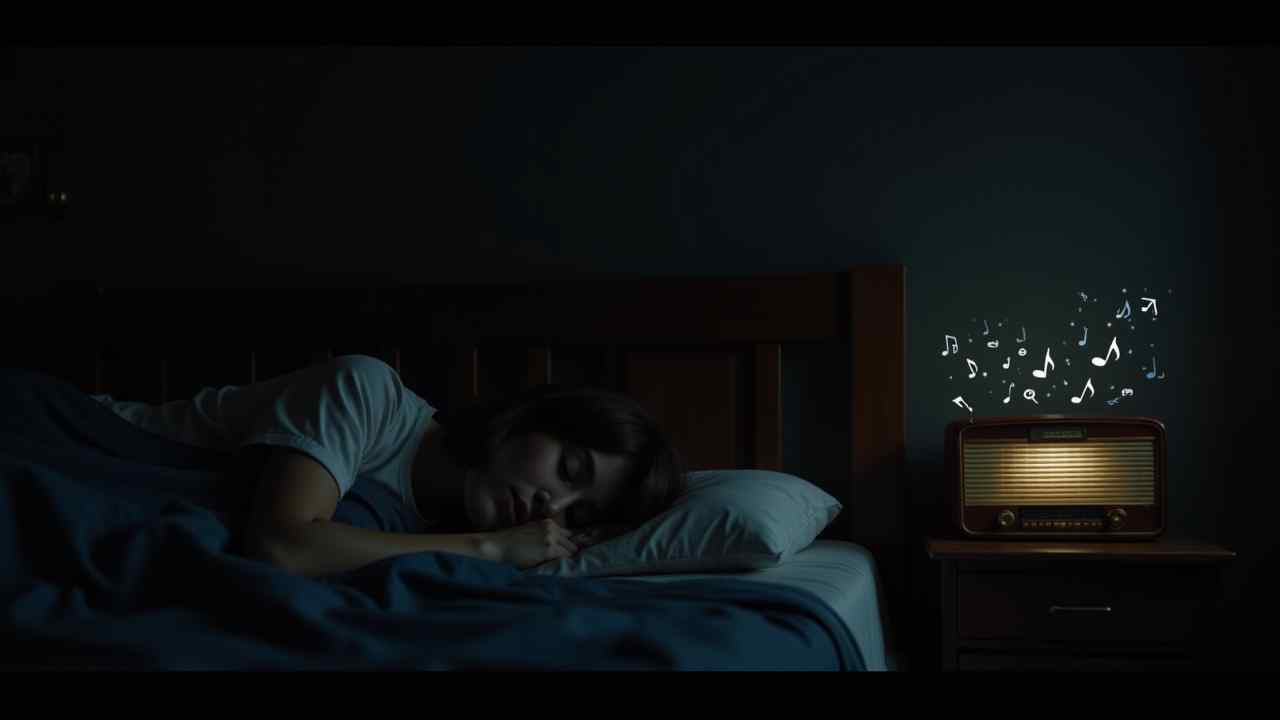
Classical Music for Sleep 😴🎶
What is "Classical Music for Sleeping"?
This is a very common, very popular idea. Can classical music help you sleep? The answer is YES. A 100% yes. But it is also a TRAP. This is a huge, common mistake. And it is very frustrating. Let's find the trap.
The "Classical Music" Myth (The Trap) 🚫
This is the "trap." You want to sleep. You think, "I'll play classical music!" You put on a "Classical Hits" playlist. You start to drift off... And then it happens. BAM! 💥 "Ride of the Valkyries" starts playing. Or Beethoven's 5th Symphony. (DA-DA-DA-DUUUM!). ( Your heart explodes. Your adrenaline is pumping. You are now 100% awake. And 100% stressed. This is the "classical music" myth. The myth is that all classical music... ...is "relaxing" or "calm." This is 100% FALSE. A lot of classical music is:
- Dramatic
- Violent
- Loud
- Fast
- Stressful (on purpose!)
The "Why": The Science of Calm 🔬
Why does slow music work? It is not magic. It is biology. It is a "hack" for your nervous system. It is a "signal" to your brain.
1. The 60 BPM "Magic Number" 🔑
This is the #1 secret. The "tempo." (The "speed"). ( The magic number is 60 BPM. (Beats Per Minute). ( Why is 60 BPM the magic number? Because it is the speed of your... ...resting heart rate. ❤️ This is a real, biological phenomenon. It is called "Entrainment." Your brain wants to "sync up" to a rhythm. When your brain hears a 60 BPM tempo... ...it sends a signal to your heart: "All is well." "The "tribe" is calm." "It is time to rest." " Your heart rate will literally slow down... ...to match the tempo of the music. This is a "relaxation response." It is a physical change. It is the opposite of a "stress" (fast) response.
2. No Lyrics (The "Brain" Hack) 🧠
This is the second, vital reason. Classical music has no lyrics. (Usually). ( What happens when you listen to a pop song? Or a podcast? Or the news? Your "language center" (in your brain)... ...turns ON. It tries to "follow" the story. It tries to "predict" the next word. It tries to "understand" the meaning. Your brain is ACTIVE. It is listening. It is not resting. It is not powering down. Classical music is "abstract." It is just "sound." It is "emotion." It is "texture." Your language center stays OFF. Your brain can "disengage." Your brain can "power down." It is a "non-distracting" sound.
3. Stress Reduction (Cortisol) 🧘
This is the "mood" part. Slow, predictable, beautiful music... ...is soothing. It is the opposite of a "threat." A "threat" sound is a sudden, loud sound. (A "jump scare," a "dog bark," a "car horn"). ( This "soothing" signal... ...tells your body to stop "Fight or Flight." (The "sympathetic" nervous system). ( It tells your body to activate... ...the "Rest & Digest" system. (The "parasympathetic" system). ( This lowers your cortisol. (Your "stress hormone"). ( It boosts your "calm" hormones. (Like Serotonin and Oxytocin). ( It is a natural, safe, anti-anxiety "pill." It calms your "racing mind."
The "Sleep Music" Vocabulary (The "How-To") 🎶
So, how do you find the "good" music? How do you avoid the "bad" music? You need the "magic words." You cannot just search for "Beethoven." (You will get the 5th Symphony). ( You must search for the tempo words. These are the Italian "mood" words. Learn these 3 words.
1. "Adagio" (The #1 "Sleep" Word) ✅
This is your new best friend. The word is Adagio. (Pronounced "Uh-DAH-jee-oh"). ( It literally means "slow." It is the 60-70 BPM "sweet spot." It is the "sleep" tempo. Search for: "Beethoven Adagio." Or "Mozart Adagio." Or "Adagio for Strings." This is how you find the slow part... ...of a fast symphony. (This is the "pro-hack"). (
2. "Largo" / "Lento" (The "Slower" Words) ✅
These are the even slower words. They are also great. Largo means "broad" or "very slow." (40-60 BPM). ( Lento means "slowly." (Also 40-60 BPM). ( This is "deep sleep" music. It is "meditation" music. It is very "grounding."
3. "Nocturne" (The "Night" Word) 🌙
This is a 10/10 magic word. A "Nocturne." ("Knock-turn"). ( It literally means "night piece." It is a "song for the nighttime." It is designed to be calm. It is designed to be emotional. And it is designed to be "dreamy." Frédéric Chopin (The composer)... ...is the King of the Nocturne. His "Nocturnes" are 10/10 sleep music.
The "Danger" List (Music to AVOID) 🚫
This is the "Do Not Play" list. This is the "stressful" classical. If you see these words, avoid them. 1. "Allegro" (The "Fast" Word): This means "fast and bright." (120-150 BPM). ( This is workout music. (This is "cardio" music). (It is not "sleep" music. 2. "Presto" (The "Anxiety" Word): This means "very fast!" (160+ BPM). ( This is "anxiety" music. It is "stressful." It will raise your heart rate. 3. "Fortissimo" (The "Loud" Word) 💥 This is the real danger. It is a "dynamic" instruction. It is often written as "ff." It means "VERY LOUD!" This is the "jump scare" of classical music. You are asleep. The music is "pianissimo" (very soft). ("pp"). ( Then, "FORTISSIMO!" The entire orchestra explodes. (Timpani drums, trumpets, etc.). ( You are jolted out of bed. Your heart is pounding. You have been "attacked" by the music. The best sleep music... ...has a low dynamic range. It is "flat." It stays "soft" (piano) the whole time.
The "Ultimate" Classical Sleep Playlist (The "Yes" List) ✅
This is your 100% "safe" list. These pieces are slow. They are calm. They are low-dynamic. And they are proven to work.
1. Erik Satie - "Gymnopédie No. 1" 🥇
This is the #1 sleep song on Earth. It is the "king." This is the "gold standard." It is slow. It is minimal. It is predictable. The melody is simple. It repeats. There are no "surprises." It is 100% "non-threatening." It is the musical version of a warm blanket. It is a 10/10 "sleep trigger."
2. Frédéric Chopin - "Nocturne in E-flat Major (Op. 9 No. 2)" 🌙
This is the most famous "Nocturne" (night piece). You will recognize it instantly. It is beautiful. It is romantic. It is calming. It is a 10/10 "wind-down" piece.
3. Claude Debussy - "Clair de lune"
This means "Moonlight." 🌕 It is another "night" piece. It is "Impressionist." It is "dreamy." It feels like a "beautiful, floating" dream. It is very relaxing. (It has a small "build-up," but it is gentle). (
4. J.S. Bach - "Air on the G String"
This is a "Baroque" piece. It is very "mathematical." The tempo is slow (Largo). It is predictable. IThe long, slow notes are very "grounding." They feel "safe" and "stable."
5. Mozart - "Clarinet Concerto in A Major (K. 622) - II. Adagio"
This is the "slow movement." (The "Adagio"). ( It is famous for being soothing. (It was in the movie "Out of Africa"). ( It is pure, calm, beauty. It is a 10/10 relaxation tool.
6. Pachelbel - "Canon in D"
This is a "wedding" song. Why? Because it is 100% predictable. It is safe. The entire song... ...is the same 8-note loop. (The "bass line"). ( It repeats. And repeats. For 5 minutes. This "repetition" is a meditation. Your brain "locks on" to the pattern. And then it "turns off." It is a 10/10 sleep tool.
The "Modern" Classical (The "New Age")
Do not forget "modern" classical! This is the "movie score" or "ambient" music.
1. Ludovico Einaudi 🎹
This is the modern king. (e.g., "Nuvole Bianche," "Primavera"). ( His music is designed to be simple. Emotional. And repetitive. He is a "neo-classical" artist. He is a 10/10 sleep aid.
2. "Ambient" Music (Brian Eno)
This is the "next level." This is "music for airports." It is "sound" with no "melody." It is purely "background." This is "sound-masking." It is a "gentler" white noise. It is perfect for "sleep."
How to Use It (The "Sleep Hygiene" Plan) 💡
You cannot just "play music" and sleep. You must build a routine. A routine is a "signal" to your brain.
1. The "Wind-Down" Routine (The #1 Hack) 🔑
This is the most important step. You must have a "wind-down." The "90-Minute Rule." (Or 60 minutes, if you are busy). ( This is your "buffer zone." It is your "off-ramp" for your brain. At 9:00 PM, the "screens go off." 🚫📱 The "music comes on." ✅🎶 This teaches your brain. It is a "Pavlovian" signal. (Music = "sleep is coming"). ( You "wind-down" for an hour. You read a real book. (No phone!). (You have a (caffeine-free) tea. You dim the lights. The music is the "soundtrack" for this.
2. The Volume (LOW!)
The music must be quiet. Very quiet. It must be "background." It should be just loud enough to hear. If it is "loud," it is a distraction. It is "entertainment." It is not a "sleep tool." Low volume is key.
3. The "Sleep Timer" Hack (The "Pro" Move) ⏰
This is the #1 "pro-hack." Do NOT play music all night long. Why? This is the "dependency" problem. (Or "habituation"). ( Your brain gets "addicted." It learns it cannot sleep in "silence." This is bad for travel. (In a hotel). (It is bad for your "natural" sleep. The Fix: Set a sleep timer. (On your phone or speaker). ( Set it for 60 or 90 minutes. This is the "magic" window. The music will get you past "light sleep." It will get you into "deep sleep." (Your "core sleep"). ( Then, the music turns off. Your brain is now in deep sleep. It will stay asleep. This gives you the benefit (falling asleep)... ...without the risk (dependency). This is the 10/10, safe, smart way.
Conclusion: A Safe, Natural Sleep Aid
Classical music is a powerful tool. It is a safe, natural, sleep aid. It is not a "myth." It is "science-backed." But you must be smart. You cannot just "shuffle" classical. (You will get a 3 AM "explosion"). ( The Rules are Simple: 1. Choose the right music. (Slow = Adagio, Largo). ( 2. Avoid the wrong music. (Fast = "Allegro," Loud = "Fortissimo"). ( 3. Use the "Safe List." (Satie, Chopin, Debussy). ( 4. Use it as a tool. (Part of a "wind-down" routine). ( 5. Use a sleep timer. (To prevent dependency). ( This is the plan. This is the "art" of relaxing sleep. Sleep well. 🌟