🩺 Black Spots on Skin: A Dermatologist's Guide (When to Worry)
🩺 A Dermatologist's Guide to Black Spots on Skin (When to Worry) 🩺
❗ CRITICAL MEDICAL WARNING: Any new, changing, or unusual black, brown, or dark spot on your skin must be evaluated by a board-certified dermatologist. Self-diagnosis is dangerous. Early detection of skin cancer is crucial. This guide is for general informational purposes only and is not a substitute for a professional medical examination.
Noticing a new dark or black spot on your skin can be alarming. Your mind might immediately jump to the worst-case scenario. However, it is important to know that the vast majority of dark spots are completely harmless. They are a normal part of skin and aging.
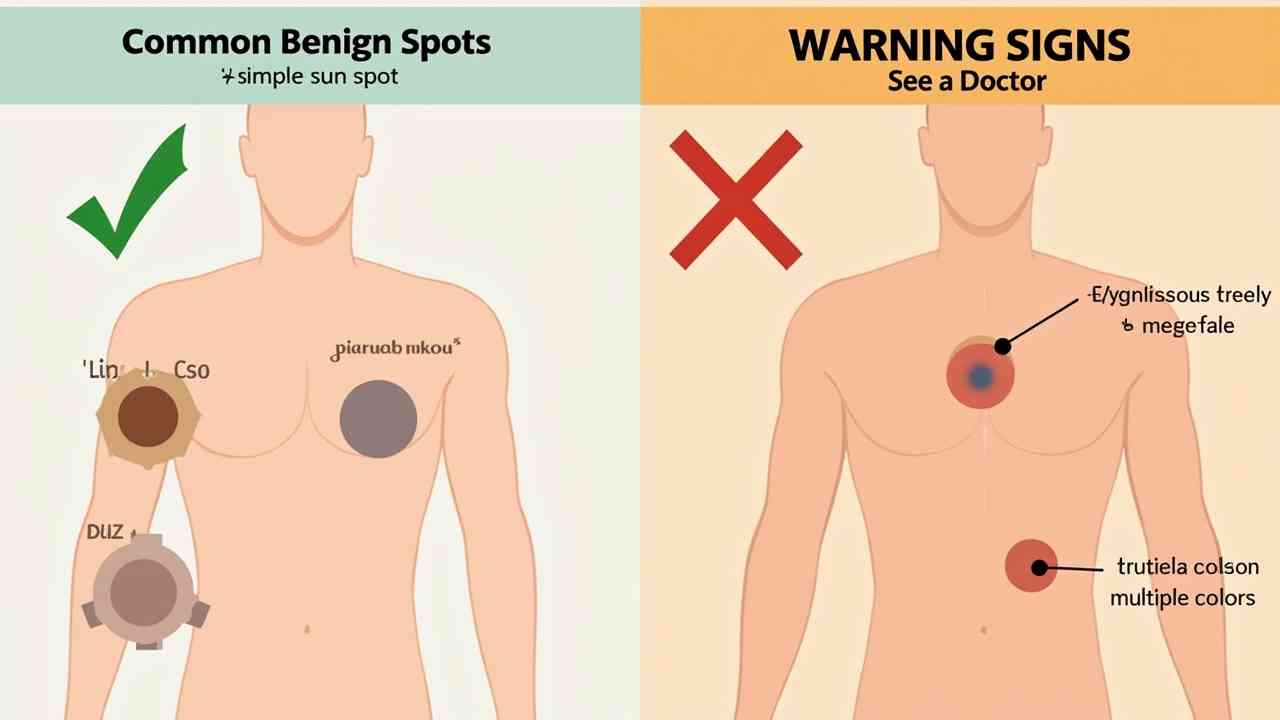
This guide will help you understand the difference. We will explain the most common types of benign (non-cancerous) spots. Most importantly, we will show you the warning signs that mean you need to see a doctor immediately. Let's get to know your skin better. ✅
🤔 What Are Most Benign (Harmless) Dark Spots?
Most of the spots that appear on our skin are benign. They are not cancerous and pose no threat to your health. They are often just cosmetic concerns. Here are some of the most common ones.
What is a Sun Spot (Solar Lentigo)?
These are the flat, brown, or black spots that are often called "age spots" or "liver spots." They are a direct result of sun exposure over time. They are very common on the hands, face, and shoulders—areas that get the most sun. They are completely harmless.
What is a Mole (Benign Nevus)?
A mole is a very common type of skin growth. It is a cluster of pigmented cells. Most people have them, and most are benign. A normal, common mole is usually an evenly colored brown or tan spot. It can be flat or raised. It is typically round or oval with a smooth border.
What is Dermatosis Papulosa Nigra (DPN)?
These are very common, small, dark, raised bumps. They often appear on the face and neck, especially in people with darker skin tones. They are a harmless type of seborrheic keratosis.
⚠️ When is a Black Spot a Sign of Skin Cancer?
This is the most important part of this guide. While most growths are benign, some can be a sign of melanoma, the most serious and deadly type of skin cancer. You should perform a skin self-exam once a month. Look for any new or changing spots. The "ABCDE" rule is the best way to spot the warning signs.
A is for Asymmetry: One half of the spot does not match the other half.
B is for Border: The edges are irregular, ragged, notched, or blurred.
C is for Color: The color is not uniform. It may have shades of brown, black, pink, red, white, or blue.
D is for Diameter: The spot is larger than 6 millimeters across (the size of a pencil eraser). However, melanomas can sometimes be smaller when first detected.
E is for Evolving: The spot is changing in size, shape, color, or is a new symptom like bleeding or itching.